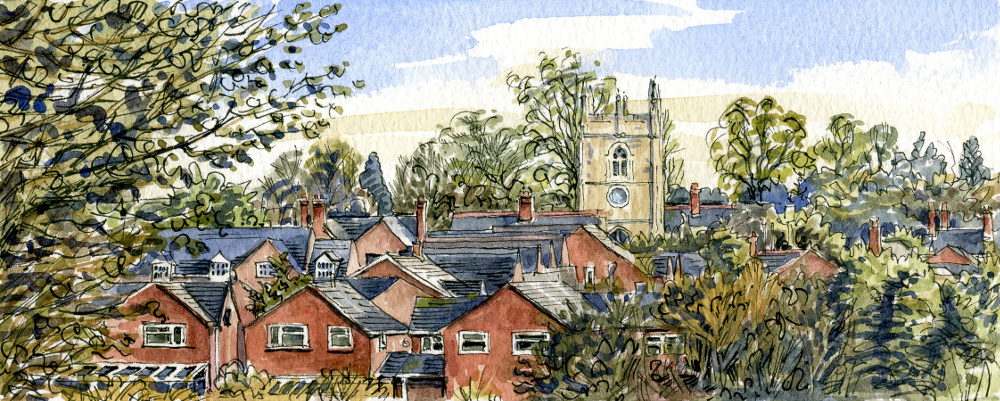

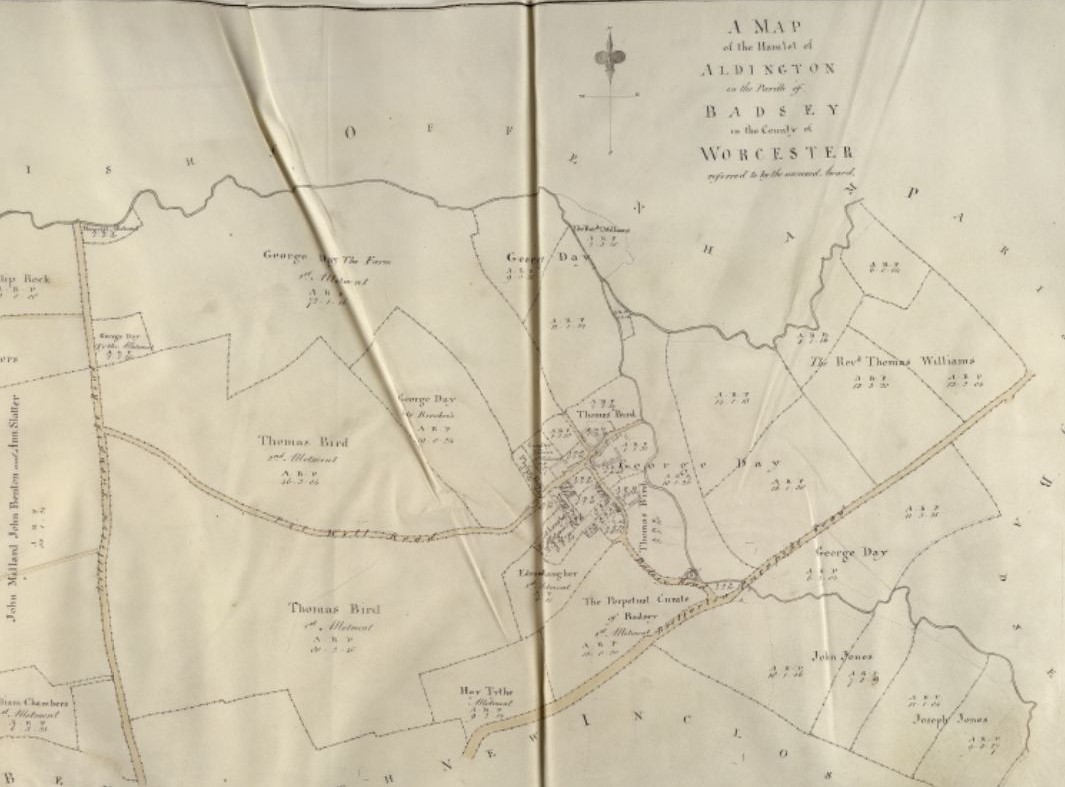
At the time that the Aldington Enclosure Act was passed in 1807, George Day was the largest landowner in Aldington, owning 189 acres, which was just over a quarter of the land. His name is prominent on the map which was drawn up, prior to the Schedules being issued the following year.
George Day never lived in Aldington and little was known about his life. So who was he? We have recently been contacted by Jenni Last, the 3xgreat-granddaughter of George Day, who has been able to tell us about his life. Read below to find Jenni’s story of her ancestor.
* * * * *
I am a great-great-great-granddaughter of George Day, through the line of his daughter Mary (1811-1873).
George Day (1764-1830) is the furthest I can reliably go back in my family tree. Probably born in Bengeworth, there is not much known about him before 1805 when he bought Aldington Farm, east of Aldington. In 1806 he acquired the Manor of Aldington, becoming ‘Lord of the Manor’ but leasing it to one William Preedy. He exchanged the farm and land with the Revd. Thomas Williams for land near the Manor, just before the Enclosures Act of 18 October 1808. Two days after the Act came into effect, he sold the Manor (which included much of the village) to James Ashwin for £12,000.
The exact date of the building of Prospect House, his home in Bengeworth, is unknown but had to be around the time George sold the Manor at Aldington. He lived there until his death in 1830 when the property was left to one of his sons, William Henry Day. Prospect House is now a Grade II listed building on the Heritage List for England.
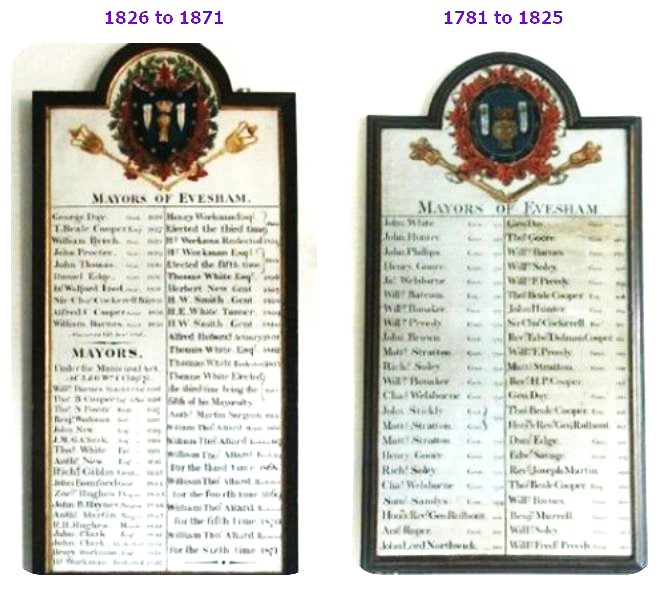
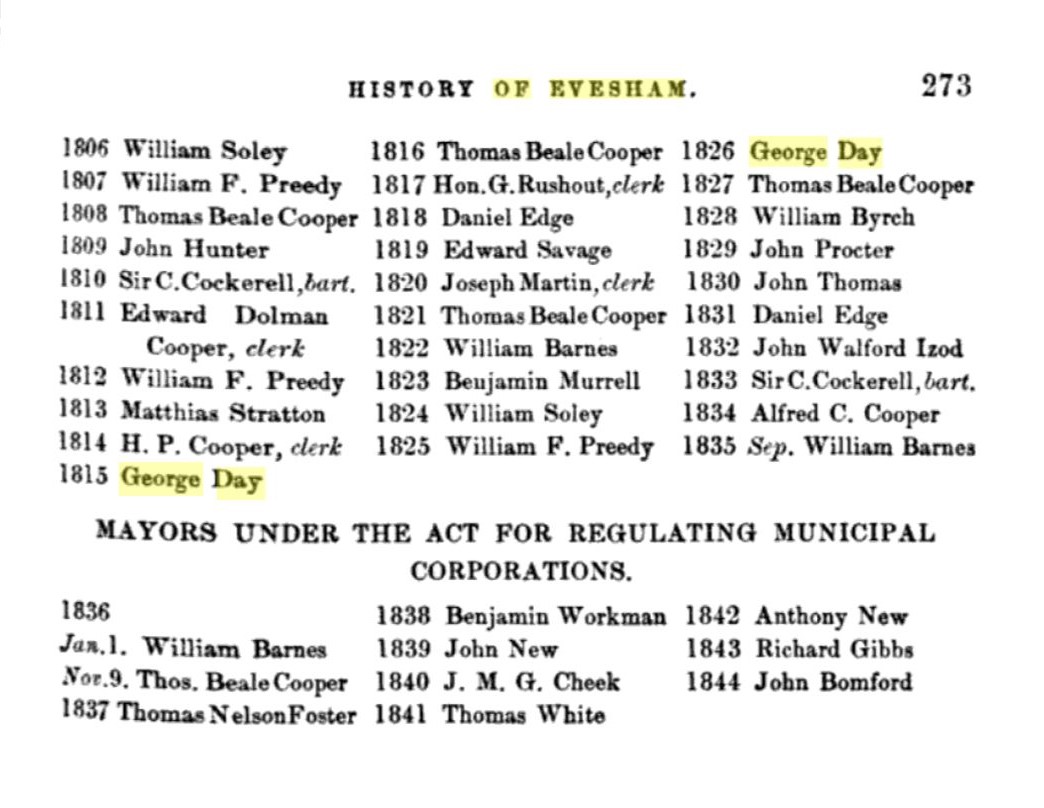
George Day was described as a gentleman and a ‘Merchant of Evesham’ and became Mayor there three times, in 1803, 1815 and 1826. His name is on the Mayoral Boards that used to be in Evesham Town Hall. ‘He is said to have speculated considerably and sometimes disastrously in local properties’ (Biggs family history) and a gazette notice of his daughter’s wedding in October 1834 in such newspapers as The Worcester Journal and Worcester Herald refers to him as ‘the Late George Day, Banker.’
In a letter to my grandmother, his granddaughter Louisa describes an oil painting of him thus: ‘He had a fine old face-fresh complexion, white hair, blue eyes and wearing a rich red coat of a satin brocade, maize-coloured waistcoat and stock collar.’
George Day’s Family History
My late father, Marcus Fortescue Yarwood (MFY) did a great deal of research into his ancestry and left me a Day family tree based on a memorial stone which was formerly in the floor of the old Church of St Peter in Bengeworth, recorded in May’s History of Evesham in 1845. It is complicated and somewhat misleading.
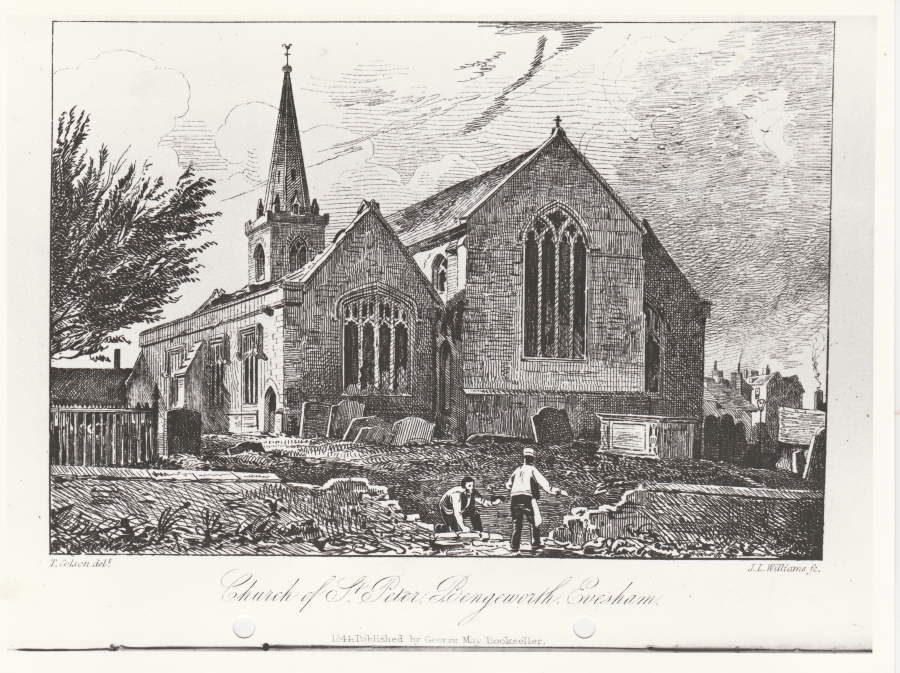
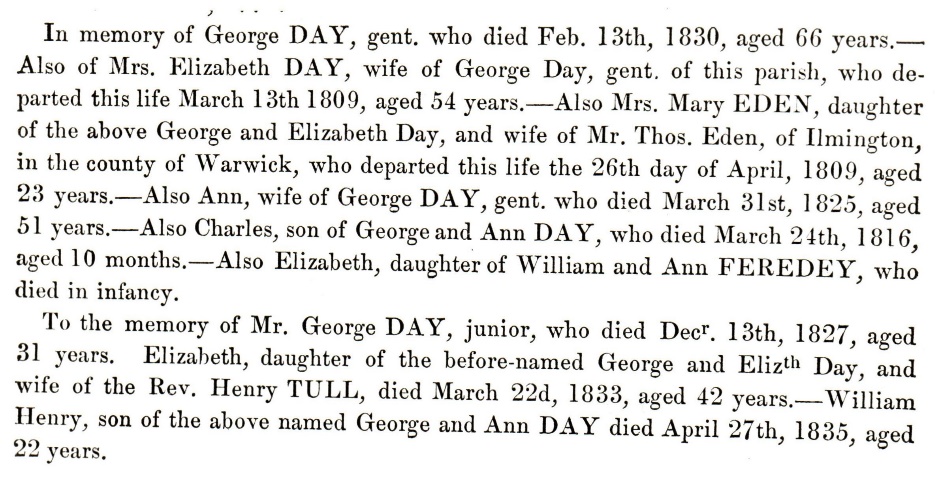
My father had assumed that George Day had only been married once, to Elizabeth in 1784, and that references to the children of George and Ann Day were to those of his son George Junior, born 1789. This made perfect sense, given some dates of death were missing. However, the discovery that George Junior died young and of George Senior’s will, written in 1829, threw the whole theory into disarray. In his will George refers to both his older daughters and to younger children yet to achieve their majority who all appear to be those of ‘George & Ann’ on the memorial. In fact George Day was married twice.
George Day Senior married Elizabeth Johnson in 1784, and their first child William was born in 1785 but only lived 17 months. Mary followed in 1786, then in 1789 George Junior who only lived 15 months. Between 1790 & 1796 Ann, Elizabeth and another George were born. This George died in 1827 so could not have been the father of William Henry on the memorial either. George’s wife Elizabeth died in 1809 aged 55. Daughter Mary died a month later, leaving Ann, Elizabeth and George Junior.
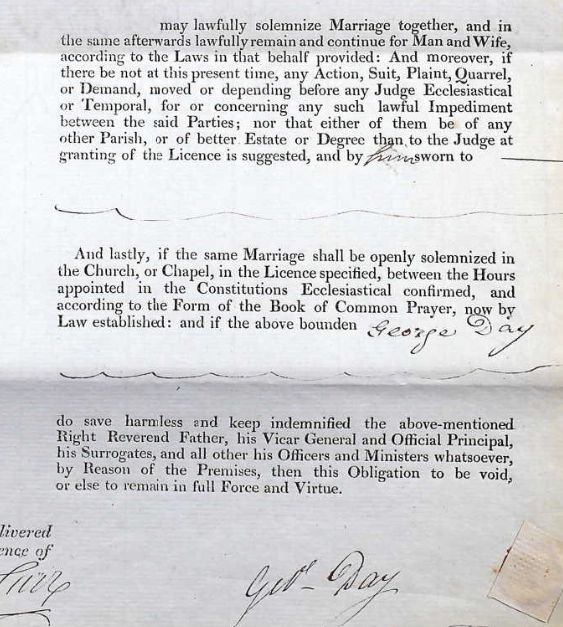
Next, I found the evidence that George Senior had married twice, the second time to Ann Steinmetz (née Eden) in 1810, a year after Elizabeth’s death. Two sets of banns exist, one recorded in Stepney and one in Bengeworth.
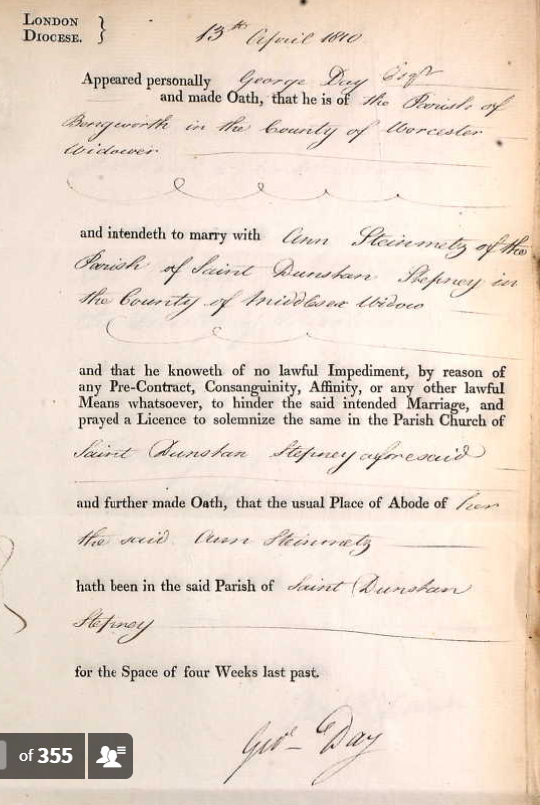
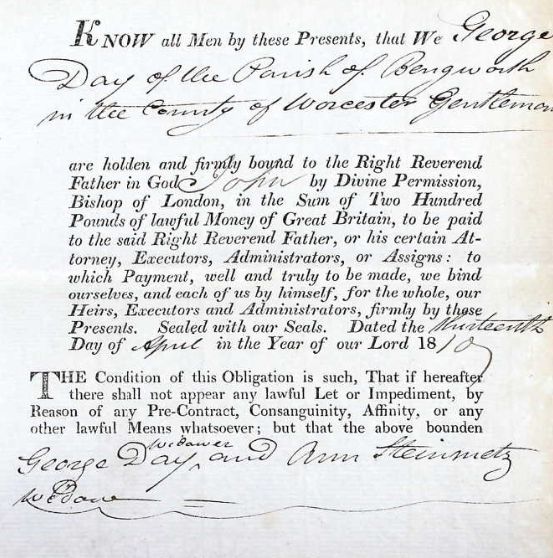
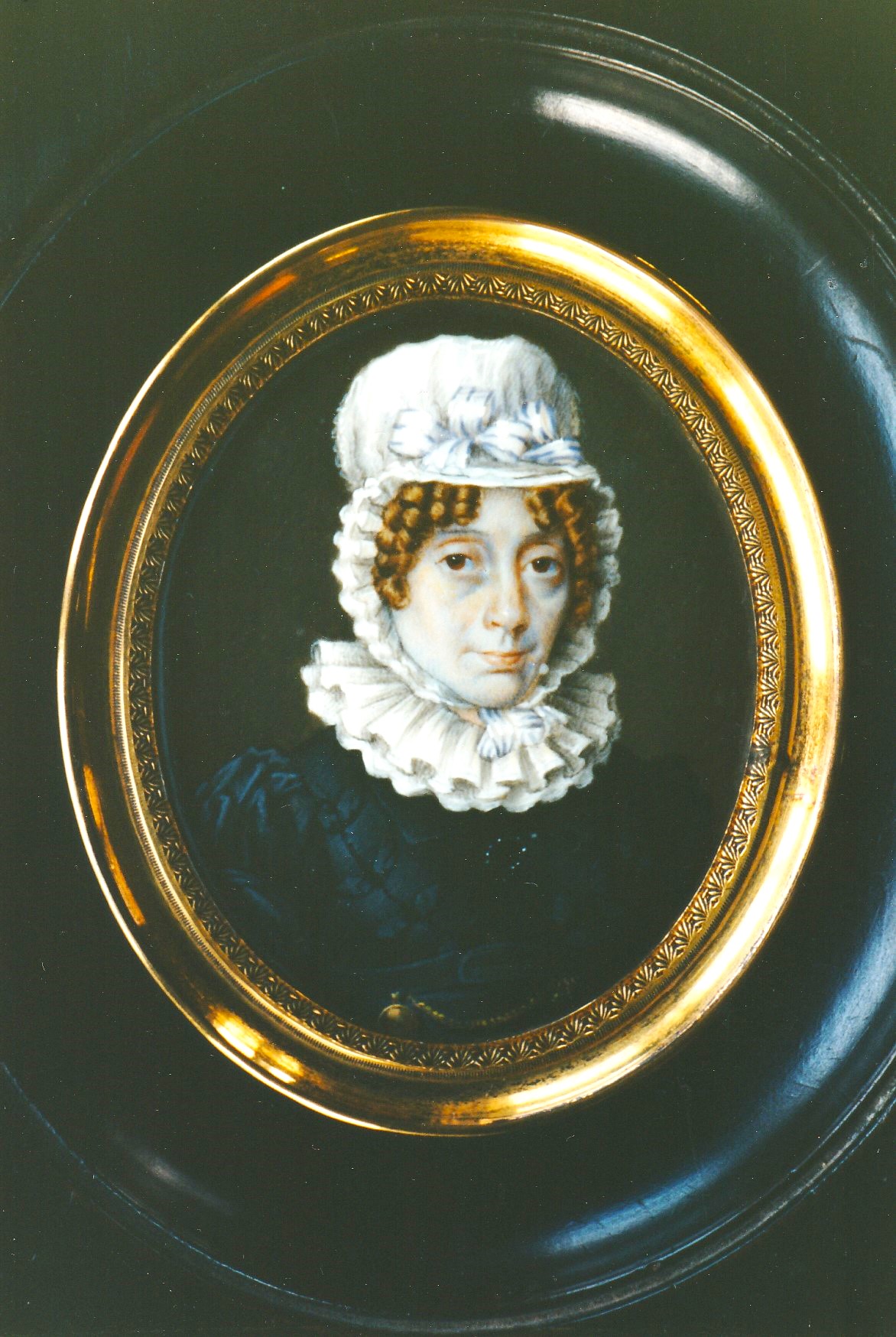
Ann Steinmetz (1774-1825) was born Ann Eden and married Benjamin Steinmetz in 1792 in Church Honeybourne. Her father, Nathaniel Eden, lived in Hill House, Ilmington, Warwickshire, and the family in Church Honeybourne were early Methodists, with references to some of them in John Wesley’s letters. The Steinmetz family, with three children, appear to have lived in Stepney where Benjamin traded as a Merchant Taylor wax/tallow chandler until his death in 1808. Nathaniel Eden refers to his ‘daughter Ann, the wife of the late Benjamin Steinmetz’ in his 1808 will.
Benjamin came from a family of bankers and ship-owners, originally from Hamburg, and was granted the Freedom of the City of London as a member of the Guild of Merchant Taylors in 1788. He traded as a wax and tallow chandler in Broad Street, Ratcliffe in the heart of London’s docklands, now Tower Hamlets. He appeared several times as a juror in trials at the Old Bailey. The Steinmetz family lived in Stepney but two of the children, Benjamin and Caroline, died young. Benjamin (Senior ) died in 1808 leaving his wife and one son, John b. 1795.
(While not directly related to the Days, John is worth mentioning as from a very young age he started an art collection -he owned a Rembrandt etching at 15 and in 1864 donated 14,000 prints and 3,000 Old Master drawings to the city of Bruges where he lived after his marriage. He had 3 sons
and 8 daughters, 5 of whom became nuns. )
In 1810 Ann married George Day, the father of her younger brother Thomas’s wife, Mary Eden (nee Day). She was 36, he was 46. George and Ann had four children between 1811 and 1818: another Mary (1811-1873), William Henry (1813-1835), Charles (1815-1816) and Louisa (1818-1845).
Ann Day died in 1825 leaving a complicated will that appears to have been drafted intially in 1810,
on her marriage to George. Benjamin Steinmetz had died at the age of 44 and left her a wealthy
widow so she came to her second marriage with son John, property and over £1200. Her will
mentions her three surviving children with George but (I think) says that John Steinmetz is to have
no claim to the property.
The two portraits below are probably Elizabeth and George, children of George’s first marriage.
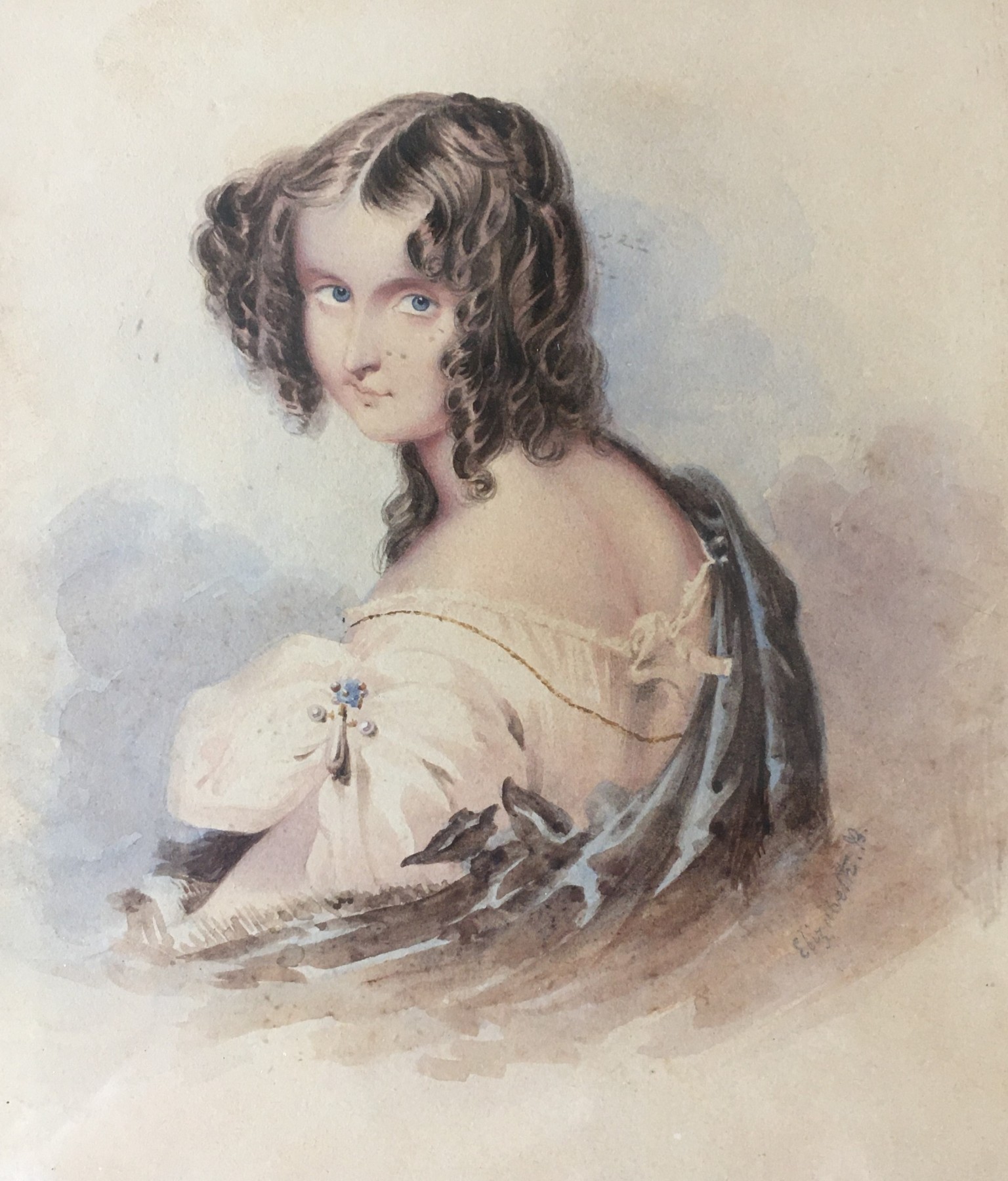
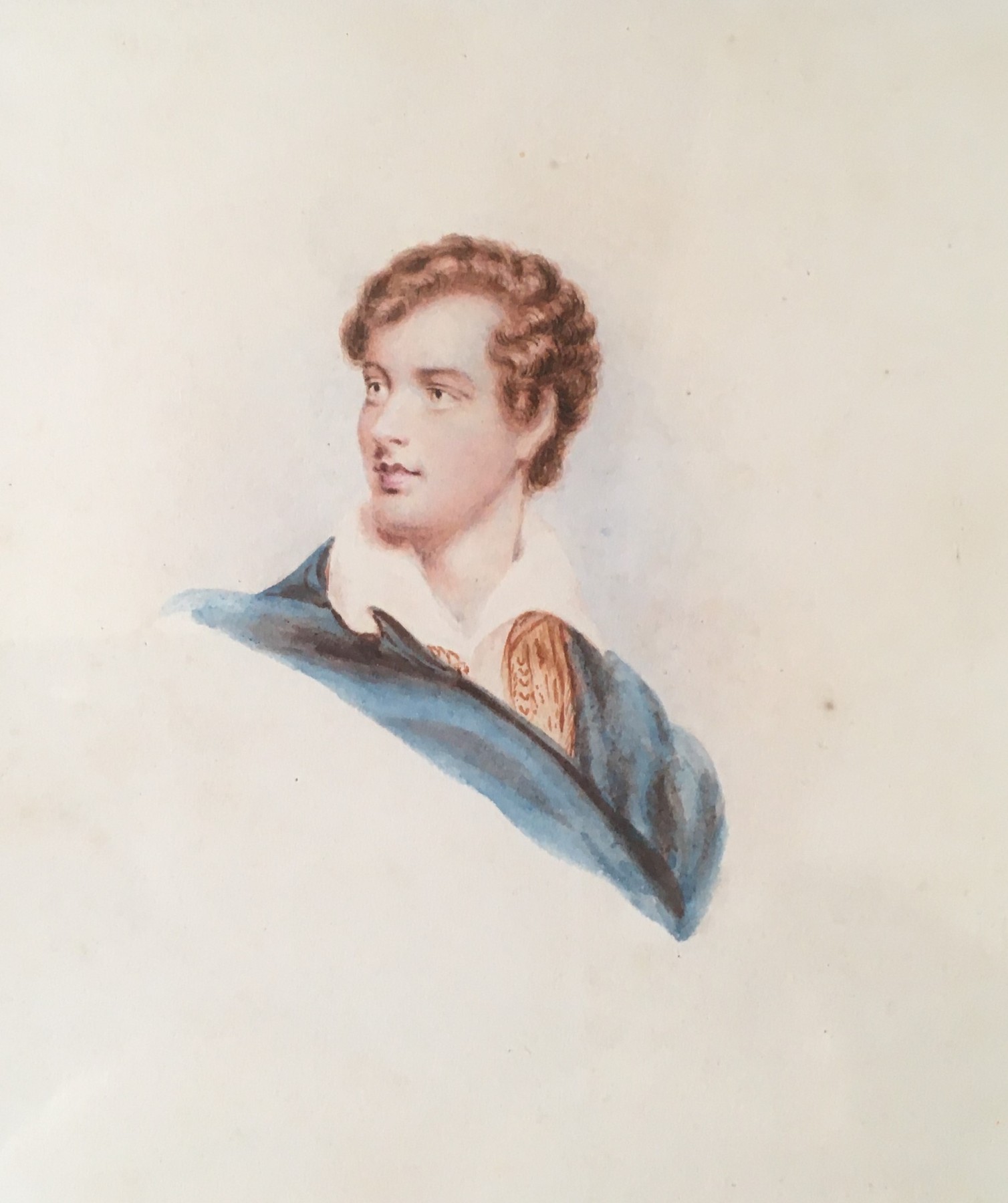
Family letters from Ann Day’s granddaughter Louisa refer to the miniature as being Ann Day (‘my
mother’s mother’)and to the water-colour portrait of the young man as being young George, (1796 –
1827, “my mother’s half-brother”). The other is probably his sister Elizabeth (1792-1833), both
children of Elizabeth Day: the word ‘Elizabeth’ is just decipherable on the bottom of the girl’s stole.
Family legend suggests that Ann painted them but as there never seems to have been any reference
in family correspondence about an earlier wife it is hard to know whether or not Elizabeth was
actually the artist or the subject of the oval miniature.
Death of George Day
George Day died at Prospect House, Bengeworth, on 13th February 1830, aged 66, five years after the death of his second wife, Ann. According to the report in The Worcester Journal of 18th February, he died “after a short but severe illness … sincerely regretted by his family and numerous circle of friends”.
Of his ten children five were surviving at the time of his death: Ann Fereday and Elizabeth Tull from his first marriage, and Mary, William Henry and Louisa (all still minors) from his second marriage. As the only son, it was William Henry who inherited Prospect House in trust until he attained his majority in 1834. It would appear that between George’s death in 1830 and the auctioning of the house in 1834 it was rented for a while to the prominent musician Muzio Clementi.
William may have had intimations of mortality as he wrote his will in February 1834 at a young age. The property was sold in August 1834, along with 200 acres, mostly for market gardening. The auction was under the direction of the Trustees to George’s will, ahead of William Henry’s achieving his majority, possibly so that he would inherit in cash? Unmarried, William Henry died in 1835 age 22, and left almost his entire estate to his sisters, and nieces, daughters of his deceased half-brother George.
Prospect House
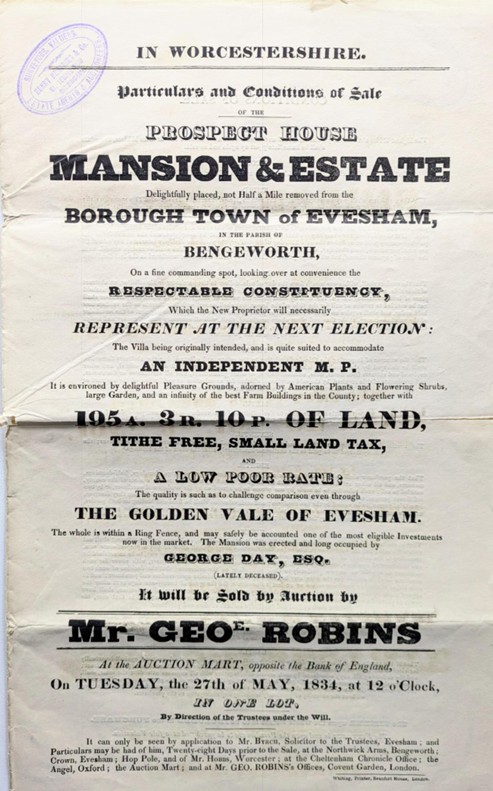
This text, copied out by my grandmother in 1918, is probably from a newspaper advertisement for the sale of Propsect House in 1834.
Vale of Evesham Worcestershire
The mansion called ‘Prospect House’ late the residence of George Day Esq., consisting of an elegant Entrance Hall, lofty & well-proportioned Dining and Drawing Room, large Library, excellent Housekeeper’s rooms, large storeroom, Kitchen and Offices, attached is a large walled Garden & altogether constituting a most desirable residence for a genteel family, the approach being by a Paved Colonnade and verandah leading from a Shrubbery and Pleasure Grounds, laid out with great taste and judgment, together with two hundred and one acres of exceedingly rich and fertile Meadow, Pasture and Arable land, all adjoining and contiguous to the Mansion and now occupied therewith by a most respectable tenant, at the rent of £600 per annum whose term therein may be made to expire at Lady Day.
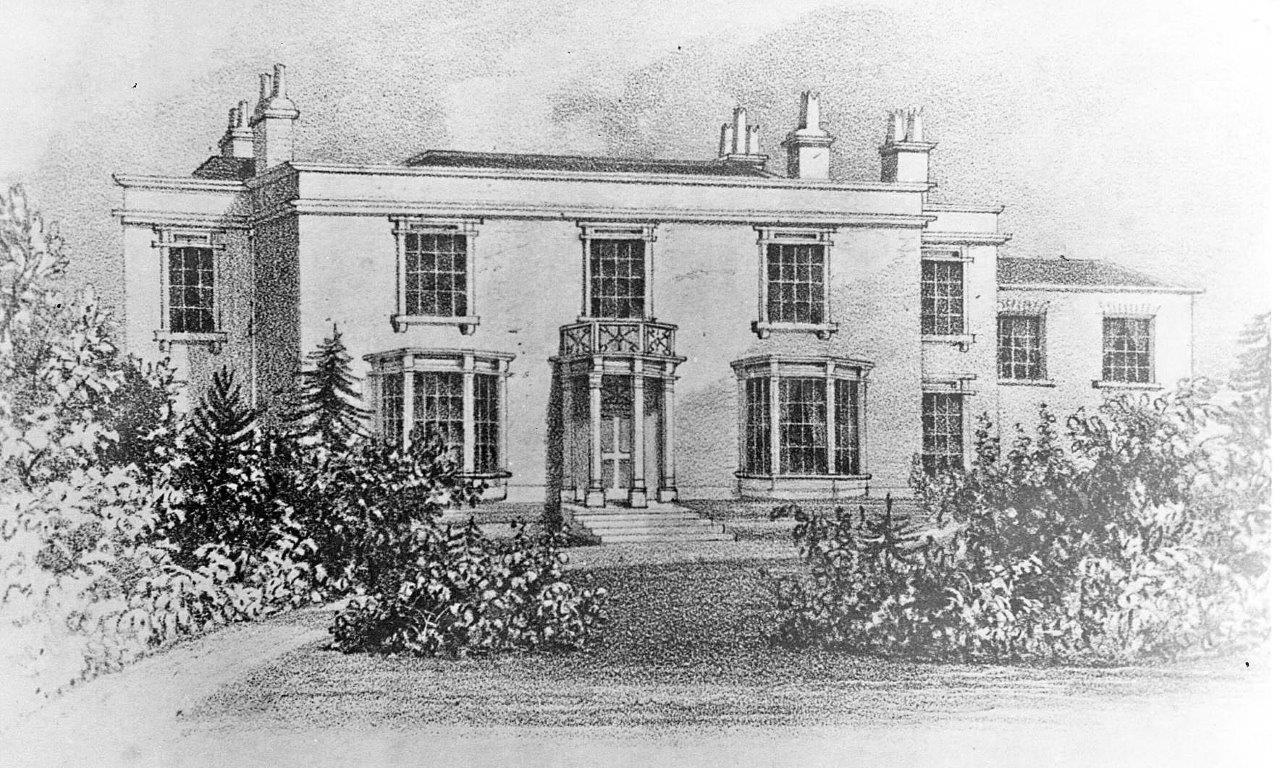
No indication of bedrooms, bathrooms, dressing rooms etc. What does exist is a photograph of the house much as it must have looked originally, taken from a steel engraving, date unknown.
George Day's Descendants
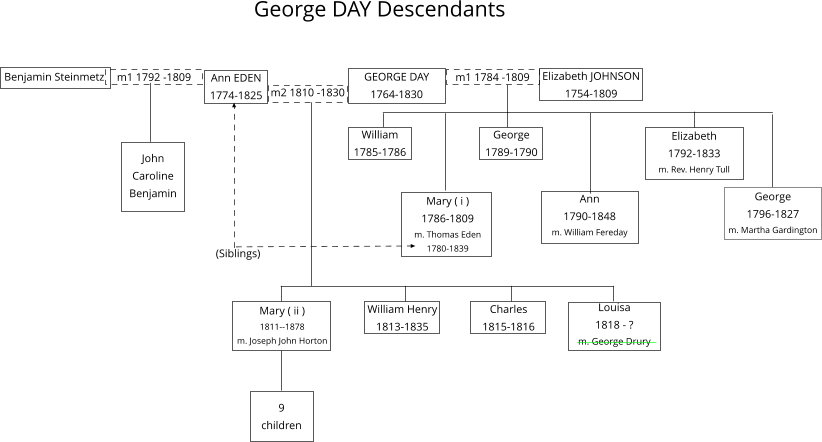
Of the five of George Day's ten children that survived at the time of his death, Ann Fereday, Elizabeth Tull, William Henry Day and Louisa Day (later Drury), all died without surviving issue.
George’s daughter, the younger Mary from whom I am descended, married Joseph John Horton, a general practitioner/surgeon in 1834 and they lived in Bradford Street, Birmingham where they had nine children several of whom became pharmacists, dentists or doctors. The Hortons also owned at one time, prior to the Industrial Revolution, a large amount of land including a deer park adjacent to Bradford Street but this had gradually been sold off and built upon.
Jenni Last, Marlow, Bucks, March 2024