
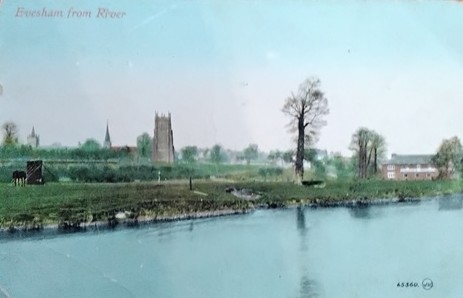
Brian Smith of Aldington is a keen collector of postcards. He has brought to our attention this postcard which is a run-of-the-mill Evesham view across the river, depicting the two churches, the Bell Tower and the Rowing Club. However, the message it carries is much more interesting.
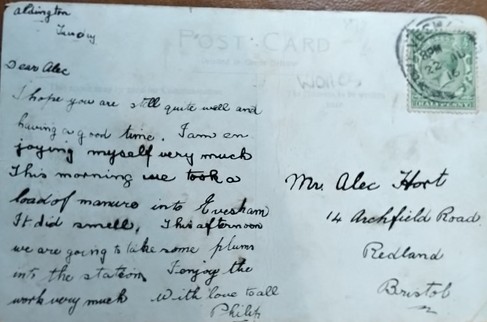
It was sent from Aldington to Bristol in August 1916, in the middle of the first World War, at the time when conscription had just been introduced. Labour for land work was very scarce, and the Government was encouraging the use of juvenile labour by reducing the school leaving age of 14 in some circumstances.
Brian writes:
We do not know the age of the sender, Philip, but he gives me the impression that he was between leaving school and reaching the minimum age to join the forces. We can take a guess at where he was employed in Aldington, at one of the two major farms, Ivy Farm or Manor Farm, where both muck and plums were produced by the cartload. It is nice to see that he was enjoying the work so much, obviously a complete change to what he was used to. An interesting snapshot in time, preserved entirely by chance.
* * * * *
“Philip” identified
So who was “Philip”? Fortunately, the recipient, Alec Hort of 14 Archfield Road, Redland, Bristol, had a fairly unusual name, so it did not take long on Ancestry to find him. And there he was, in both the 1911 and 1921 census living at Archfield Road, along with brother, Philip. From this we were able to find out more about Philip.
Philip William Hort was born on 7th November 1901 in Bristol, the second of six children of Albert Greenway Hort, an accountant, and his wife, Florence Ellen. The “Alec” that he was writing to was his little brother, Alec James Hort. At the time the postcard was written, on 22nd August 1916, Philip would have been aged 15¾ and Alec aged 6½.
Philip, along with his brothers, was a pupil at Bristol Grammar School and had probably left school that summer. Unlike his older brother, John Cecil Hort, born July 1898 and who enrolled with the Somerset Light Infantry, he was too young to be eligible for conscription.
How Philip came to work in the Vale of Evesham and for how long he stayed is unknown. Possibly it was through the Boy Scouts’ Association which was one of the first youth organisations to provide practical assistance to the war effort. In The Evesham Standard of 15th July 1916, in a report of the proceedings of the Worcester Chamber of Agriculture, it was noted that a number of ladies and gentlemen in the Birmingham district were willing to give their holidays to assist farmers; also about 50 boys from Camp Hill Grammar School and Boy Scouts who were willing to camp out and do what they could.
At that stage it was thought that the class of labour (ie the ladies and gentlemen from Birmingham - no more mention was made of the schoolboys and Boy Scouts) was of very little value to the farmer. The weather conditions had made hay-making uncertain, and one could not put unskilled labour to hoe a valuable crop. When the weather cleared up there would be any amount of work that they could do on the farms. It seems that, by August, the situation had changed, and some farmer were happy to employ whatever help they could get.
What happened to Philip and Alec
We do not know how long Philip remained in the Vale of Evesham – whether it was just for the summer or for the duration of the war. But we do know what happened to him after the war and there is a photo on the web of the two brothers in old age.
At the time of the 1921 census, Philip was following in his father’s footsteps and training as an accountancy student. He became a successful chartered accountant and remained in the Bristol area all his life, dying there on Christmas Day 1978, aged 77.
Alec joined the Merchant Navy. He became commodore of the British and Commonwealth fleet in 1969 and was made an OBE for his services. He died in 1979, aged 79.
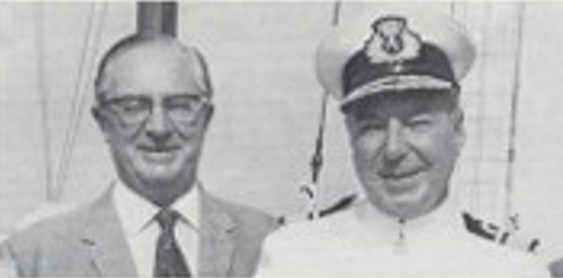 Philip Hort (left) with his brother, Alec Hort, on the occasion of Commodore Hort’s retirement in September 1970. Published in Manifest, the Seagoing Supplement to Clanman magazine.
Maureen Spinks, February 2026