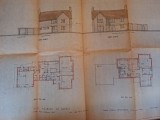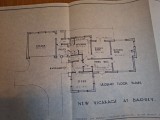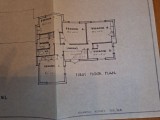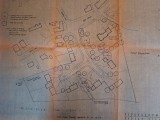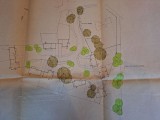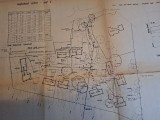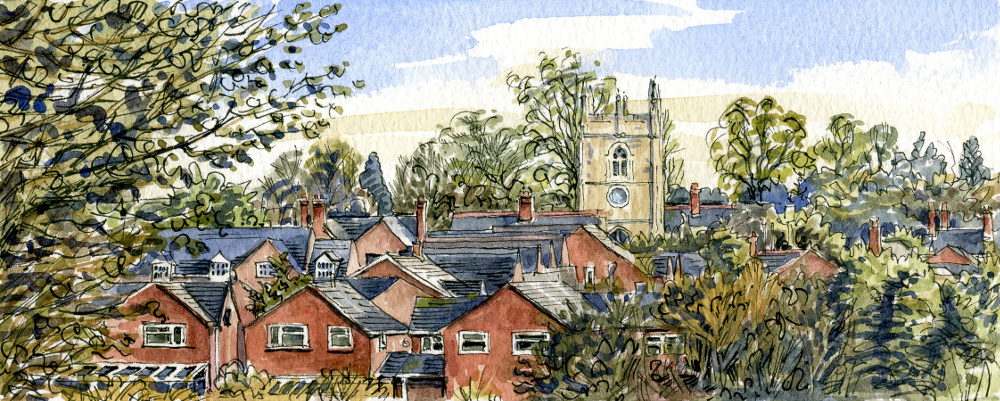

Some interesting papers were discovered in the loft of the current vicarage containing letters and plans relating to its construction and the development which was built in place of the old manse. The letters are predominantly from Christ Church, Oxford, who owned the land and the Worcester Diocesan Dilapidations Board who dealt with the disposal of old vicarages that were in need of either renovation or demolition. The letters are addressed to Rev. Peter Braby who was the incumbent at the time.
The first letter from Christ Church, dated 8/7/1969 promised to apply for a grant for £2000 from the patrons and expected the Church Commissioners to contribute the same sum. Rather optimistically (as we shall see later) the writer of the letter, Mr. Gray, expected this to cover the cost of the new house. It appeared that the Dean of Christ Church would normally have been dealing with these matters, but had unfortunately died unexpectedly. Mr. Gray stipulated as part of the grant conditions that the house should have “an adequate and economical heating system and lots of fitted bookshelves in the vicar’s study”.
A communication from 22/10/1969 stated that the governing body of Christ Church had approved the sale of the old vicarage and a new one to be erected. The £2000 grant had also been approved.
Following this Rev. Braby must have written a letter to Christ Church informing them that the Church Commissioners were pressing for a smaller house than the one the architect had designed. It is not clear what their reasons were, but most likely financial. Mr. Gray’s response (31/10/1969) was given the amount of money the sale of the land would generate it was “ungenerous”. He asked Rev. Braby to inform him of the changes as the grant had been made based on the architect’s plans. Mr. Gray was keen that the central heating system and book shelves in the vicar’s study be maintained.
A letter from the Worcester Diocesan Dilapidations Board dated 29/6/1970 stated that tenders had been invited for the building of the new vicarage. Seven quotes had been received, all from local builders, with the furthest one coming from Worcester. There was a range of quotes from £12,756 (Maudesley and Jordan, Childswickham) to £16,348 (John Hall, Pershore). The architect offered a good reference for Maudesley and Jordan, who stated they could start within 6 weeks and complete within 6 months.
In a letter dated 28/7/1970 from the Worcester Diocesan Dilapidations Board it is clear that the Childswickham company was chosen. They stipulated that the doorways in the reception rooms should be 2’9” wide (the standard measurement for houses now but not then) and that as the house was going to be a parsonage, a 6’ bath was required. (Were vicars taller then?) Work on landscaping was not to commence until the building work had finished which I suspect was a further attempt to cut costs.
A local estate agents (Griffiths) prepared the details for the sale of the old vicarage and land in February 1971. The initial blurb describes the village of Badsey of 1850 residents, expected to rise to 2000 but not much more. (More than 50 years later this is sadly not the case!) There was a Post Office, seven other shops and three banks. Planning permission had been granted in June 1969 for 7 detached houses on the land. Parts of the old vicarage were said to be over 200 years old. There were a “good number of outbuildings, garages, stables and a clubroom. The house has 5 bedrooms, 4 reception rooms, 2 kitchens, attics and a bathroom.” (Only 1 bathroom for a house of that size!) There was a pump in the cellar – did it suffer from flooding? The lot of 2.55 acres was sold in an auction at The Star Hotel, Evesham on 5/4/1971 for £12,000. Two days later, the purchasers, Vale Properties requested permission from the vendors to erect 9 houses on the plot and offered to pay a further £1500.
A further letter dated 15/7/1971 stated that they had planning permission to build 10 houses now and offered to pay the vendors £2000. A salutary lesson when dealing with property developers!
In July 1971, the Vicarage garden works was put out to tender and 3 quotes were received ranging from £327 to £900. Following the usual pattern, the cheapest quote was selected and Warwick Landscapes of Leamington Spa were appointed.
In a letter dated 18/8/1971 the vendors agreed to 10 houses being built, provided a row of trees were planted and certain others on site not chopped down. A covenant was proposed “the trees not to be harmed or molested in any way”. The solicitors pointed out that this would be hard to enforce.
The final letter in the collection dated 24/9/1971 suggested the name “Vicarage Gardens” but as we now know the name Allsebrook Gardens was chosen instead.
An undated incomplete document which is part of the contract between the Church Commissioners and Vale Properties states that there should be no building or future building of “a place of amusement, hotel, tavern or inn, nor shall any spiritous or fermented liquors at any time be sold……nothing to be a nuisance, annoyance or disturbance to the incumbent” So our current residents in Allsebrook Gardens cannot sell any home brew or have any raucous parties!
Gill Woods, January 2026