
My time at the Botanical Gardens came to an end owing to the Curator wanting too much Sunday work. So I had to look round again. I happened to meet my oldest brother and he recommended me to write to our cousin, Tom Remington, who was market gardening at Badsey near Evesham.
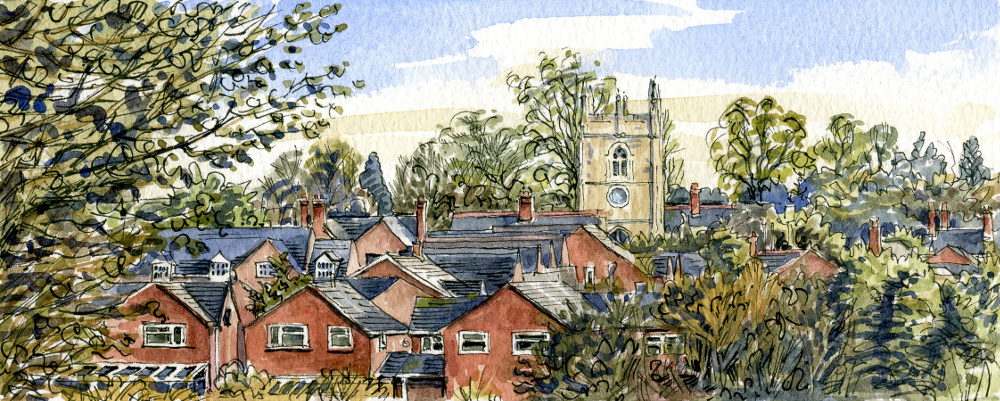
So on June 19th 1899 I was met at Evesham Station by Tom with a dog-cart – his arm in a sling having been pitched out of the vehicle some days before. It was a beautiful evening and I liked the first view of the village from Horsebridge Hill with the church tower rising over the orchards. The next day he showed me his ground (now occupied by council houses) on the left-hand side of the “pike”. I had some conversation with one of his men, George Moisey. They were busy with the strawberries. Then we visited other growers who all seemed quite pleased to answer questions, and let us walk over their holdings. I thought this was just the place for me and I returned to Manchester fully determined to settle there. So I started to make arrangements.
It was of course necessary to see my parents who were then living at Grange-over-Sands. They agreed to let me have some capital, as I intended to erect some greenhouses. This meant I had to plan this out with a Manchester firm who proved very helpful.
Early in July I saw Lancashire v Sussex. Mold bowled to Ranji and hit him on the leg. Ranji shouted, Mold came and apologized and Ranji went on to make a good score.
I took the opportunity of seeing a Test Match. July 18, 19, I went to the two test days. F S Jackson was captain of England and during Australia’s second innings when time was valuable, the butler came out of the pavilion with a tray of refreshments. He had to pass Jackson, who curtly waved him back. The man stood irresolutely for a moment and the crowd shouted, “Bring it here”. The match was drawn. Noble did well 60 not out and 89.
Then as it was probably that once settled I should find it difficult to get away in the summer (it was easier at Christmas as work on the land was slack) I was asked to join my two brothers Frank and Gilbert and we went again to the Lake District. On the way we called at Barrow-in-Furness and saw the launch of the battleship Vengeance. We were on Walmey opposite the launching ship, so we had a good view. All went well until some time after the ship had taken the water; a large wave suddenly broke on the shore and those standing on the edge got a good wetting. We reached Newlands on July 26 and were soon busy as before climbing the mountains. We had one night at Wasdale, having been up Scafell Pike and then on to Scafell by the Lords Rake. I alone ascended Kirk Fell on the way back. The last few days we stayed at the Buttermere Hotel. We had one afternoon in a boat on Crummock Water. I left on August 9th and went to Cockermouth, Workington and Whitehaven to see if there were prospects for selling produce in those towns.
When I got back to Badsey, I set about getting hold of some land. This was not easy. I was offered some very fould land far from any road. But at last I had an offer to rent about 1 acre in the “Fourteens” from Mr John Poole, and by the middle of September it was fixed up, on a lease drawn up by my brother John. This is where my initial mistake was made. I erected 3 greenhouses and sunk nearly all my capital, leaving very little for current expenses. It would have been much wiser to have had more land with one small greenhouse. But all my previous experience had been greenhouse work. On looking back I can see it would have been far better to have come to Badsey instead of going to the large London nursery in 1894. I could have worked for someone and got experience in market gardening, in which I was sadly lacking, and taken my time in choosing the most suitable land. William Churchill came and worked for me. He was a skilled cultivator and a splendid worker, but after two years I found I could not afford to pay him what he was worth and he took some land of his own and very fortunately he had a second crop of egg plums which sold well. I engaged a boy at 3/- a week.
Now I must try to say something about market gardening as carried out in the Vale of Evesham. The parish of Badsey had by degrees changed during the last hundred years from a purely agricultural parish to one almost entirely given up to market gardening. This process was greatly helped by the Evesham Custom, which gave the tenant security of tenure and enabled him to dispose of his holding to another tenant at an agreed price, after introducing him to the landlord or his agent. The latter generally agreed to let to the new would-be tenant after enquiries as to his suitability. In some cases the value of the tenant right exceeded the freehold value. The landlord for his part received a much greater cut than he had when the land was part of a farm. So when a farm became vacant, the owner let the land out in small plots at the increased rent. It was also understood that these rents should not be raised, unless the landlord made some major improvement, ie built a barn or such like. The upkeep of the roadways on the farm always was difficult. It was often solved by the landlord providing the stone and the tenants doing the work.
The crops were fruit, vegetables and some flowers and herbs. The soil varies very much even in one parish, but a great deal of land in Badsey parish is heavy clay. This, if dug before the frosts of winter and left rough, break up in the spring and give a fine tilth. In places this clay is overlaid with a thick bed of gravel, which gives a much lighter soil. Many gardeners found it best to have some land of each kind. Most of the old established growers had several plots in different parts of the parish. This had many advantages from a cultural point of view but necessitated a much larger stock of tools to save moving them.
The average rainfall is about 24 inches a year. The great bugbear is the spring frost. It used to be the custom to plant plums on the low sheltered lands and a great many plantations have been grubbed up in the last few years because these low situations were so much more subject to frost damage.
My greenhouses were of simple construction with low brick walls and were well finished by the middle of March and we were able to get a crop of cucumbers and tomatoes. My landlord, Mr Poole, went into Evesham every day with his trap, kindly took them to a shop in Evesham. We raised a lot of tomato plants for outdoor planting and an advertisement in the local paper met with good response. The tomatoes were followed by radishes for early spring work. It was not very difficult to market the produce. There was an auction market in Evesham held every morning and in Badsey we had a dealer, William Pethard, who had a stand in Birmingham market and was always ready to take produce. I found him to be very straightforward. Then there were many growers who sent all their produce to a Commission Agent, who provided all empties. Then produce had to be taken down to the station. I had little trouble with this as a friendly neighbour would always take it down for a small sum. The salesman sent a cheque at the end of the week. Railway carriage had to be deducted and there were occasions when instead of a cheque one received a bill for the carriage.
There was no attempt at organized co-operative marketing, but there was some attempt at working together. Some Badsey growers still grew some wheat or barley. These were collected when ready to a central spot and a threshing machine was hired. The grain was then taken down to Aldington Mill to be ground, the flour was taken home and oftimes was made into bread. There was another way in which there was combined action. If a grower met with an accident or had a long illness, his neighbours joined together and put in a day’s work. A close friend of the man to be helped superintended operations, as he was able to tell what was wanted. Sometimes as many as thirty turned up and they gave of their best and as they were all experts, it was of the greatest possible help.
Another way help was given was by lending tools, especially if a new form such as a Drill. I had one, which was an improvement on the ordinary brush drill and it was in great demand.
1900
I gradually increased my holdings, but never had more than 15 acres.
Our family now lived at Grange-over-Sands where I spent Christmas 1900. In August I heard that Father had had a stroke and I went up to Grange and found him barely conscious. He died on Aug 27 1900 and so I had another journey to attend the funeral. This was at the little village of Lindale, close to the ancestral home of the Binyons’ “Merlewood” which had passed out of the family’s hands.
At the end of September I had a visit from my cousin, Arthur Fynes Clinton. We had many tastes in common and had two long walks, one to Shipston-on-Stour and the other over Bredon Hill to Tewkesbury.
The Vicar, Reverend W H Price, was very good to me and I spent much time with him deciphering, cataloguing and copying old Parish accounts. He told me to take possession of a seat in church, which I have occupied ever since. He also pressed me into the Sunday School to take the oldest boys. By this I got to know many parents, which was a great helps as the first winter seemed very long as I knew hardly anyone. Tom Remington left soon after I came.
Gilbert was now at Exeter College, Oxford, and Mother came to live there, so I had Christmas there. Gilbert showed me all the sights and took me into several colleges. He had a friend “Du Pave” whom he thought might become famous. He became a Judge and I saw him next at Worcester Assizes, many years after.
1901
Early in 1901 when at the Vicarage a message came to say that the Queen was dead. We had a Memorial Service on Feb 2 1901.
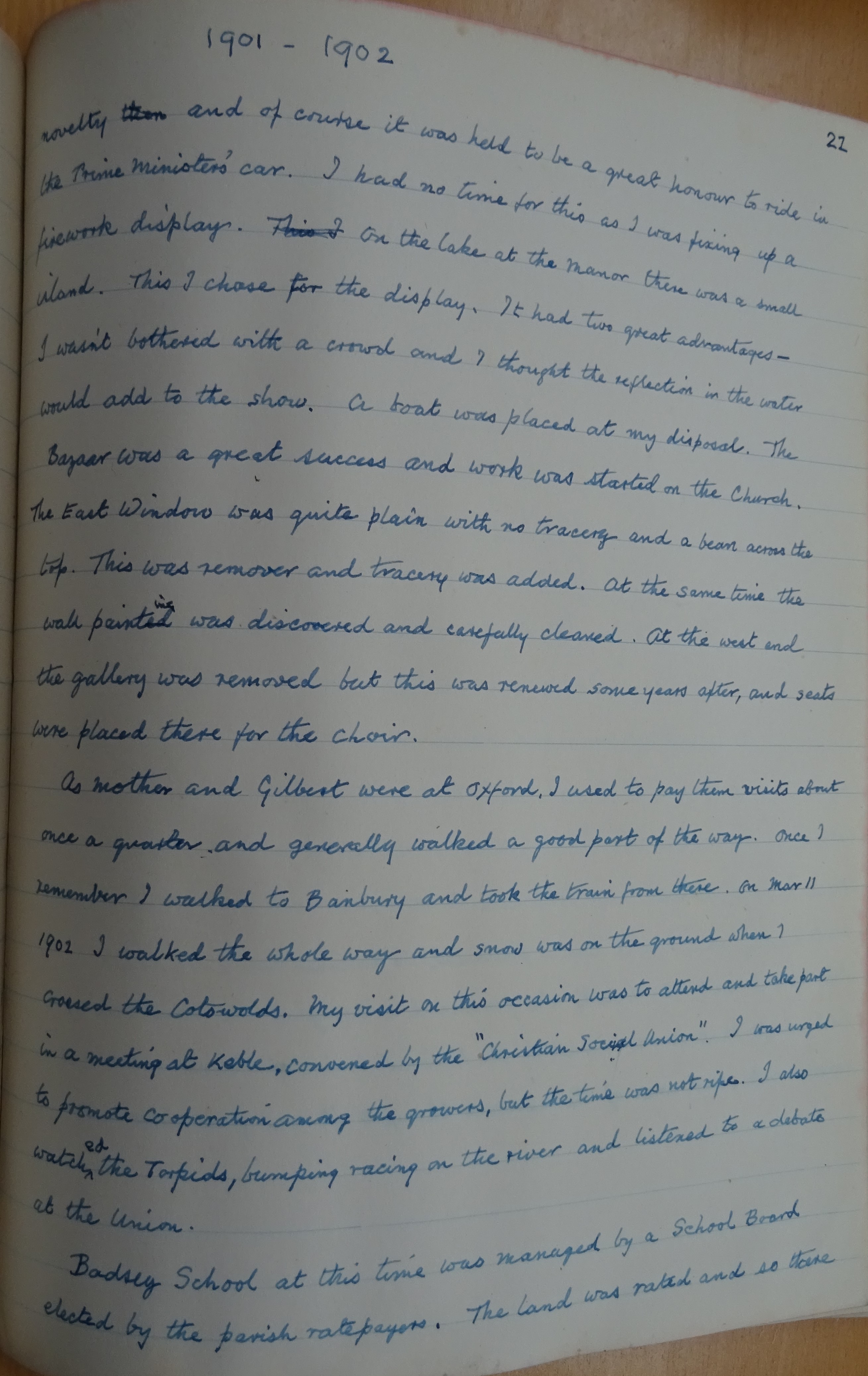
Early in March I saw in the Church porch a notice of a parish meeting, so I went to see what happened. It was to elect the Parish Council and the father of one of my Sunday School boys said, “I will nominate you. I think it might amuse you to get on the Council.” The voting was by show of hands and to my surprise I was elected and began thus to be initiated into Local Government. I remained a member for 50 years.
At the end of August there was a bazaar at Wickhamford to raise money for restoring the church. It was a grand affair as the Prime Minister, A J Balfour, was present and made a speech. He raised quite a lot of money by giving people rides in his car. Cars were then a great novelty then and of course it was held to be a great honour to ride in the Prime Minister’s car. I had no time for this as I was fixing up a firework display. On the lake at the manor there was a small island. This I chose for the display. It had two great advantages - I wasn’t bothered with a crowd and I thought the reflection in the water would add to the show. A boat was placed at my disposal. The bazaar was a great success and work was started on the church. The East Window was quite plain with no tracery and a beam across the top. This was removed and tracery was added. At the same time the wall painting was discovered and carefully cleaned. At the west end the gallery was removed but this was renewed some years after, and seats were placed there for the choir.
1902
As Mother and Gilbert were at Oxford, I used to pay them visits about once a quarter and generally walked a good part of the way. Once I remember I walked to Banbury and took the train from there. On Mar 11 1902 I walked the whole way and snow was on the ground when I crossed the Cotswolds. My visit on this occasion was to attend and take part in a meeting at Keble, convened by the “Christian Social Union”. I was urged to promote co-operation among the growers, but the time was not ripe. I also watched the Torpids, bumping racing on the river and listened to a debate at the Union.
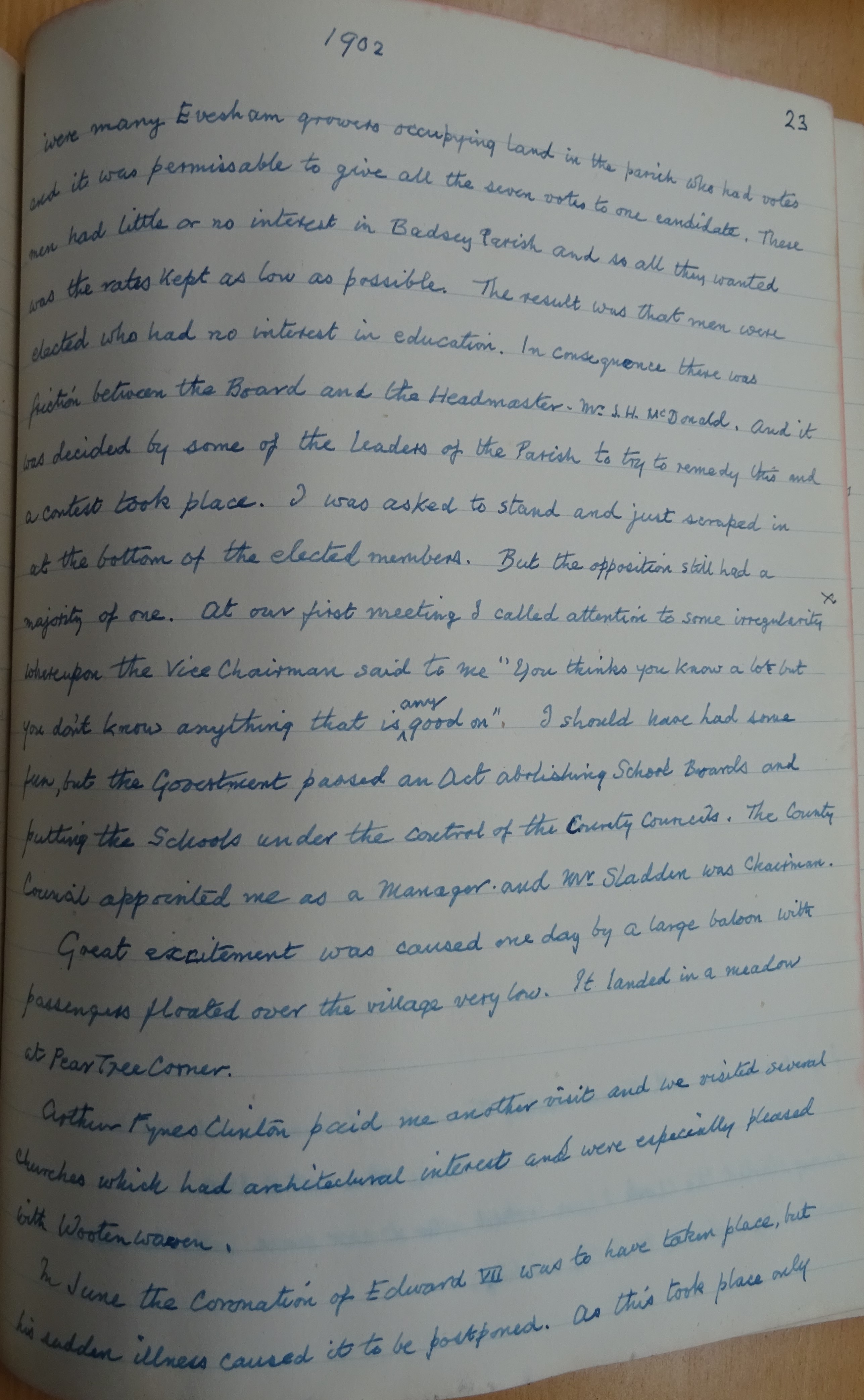
Badsey School at this time was managed by a School Board elected by the ratepayers. The land was rated and so there were many Evesham growers occupying land in the parish who had votes and it was permissible to give all the seven votes to one candidate. These men had little or no interest in Badsey Parish and so all they wanted was the rates kept as low as possible. The result was that men were elected who had no interest in education. In consequence there was friction between the Board and the Headmaster, Mr J H McDonald. And it was decided by some of the leaders of the Parish to try to remedy this and a contest took place. I was asked to stand and just scraped in at the bottom of the elected members. But the opposition still had a majority of one. At our first meeting I called attention to some irregularity whereupon the Vice Chairman said to me, “You thinks you know a lot but you don’t know anything that is any good on.” I should have had some fun, but the Government passed an Act abolishing School Boards and putting the schools under the control of the County Councils. The County Council appointed me as a Manager and Mr Sladden was Chairman. A H Savory of Aldington Manor and J Sladden had both been rejected at the previous election.
The boys often came on walks with me on Saturday or Sunday afternoons. On Good Fridays we went on the hills and collected primroses and moss for Easter decorations.
Although there are none now, yet in these times nightingales were to be heard every night from the end of April and throughout May.
Great excitement was caused one day by a large balloon with passengers floated over the village very low. It landed in a meadow at Pear Tree Corner.
Arthur Fynes Clinton paid me another visit and we visited several churches which had architectural interest and were especially pleased with Wootten Wawen.
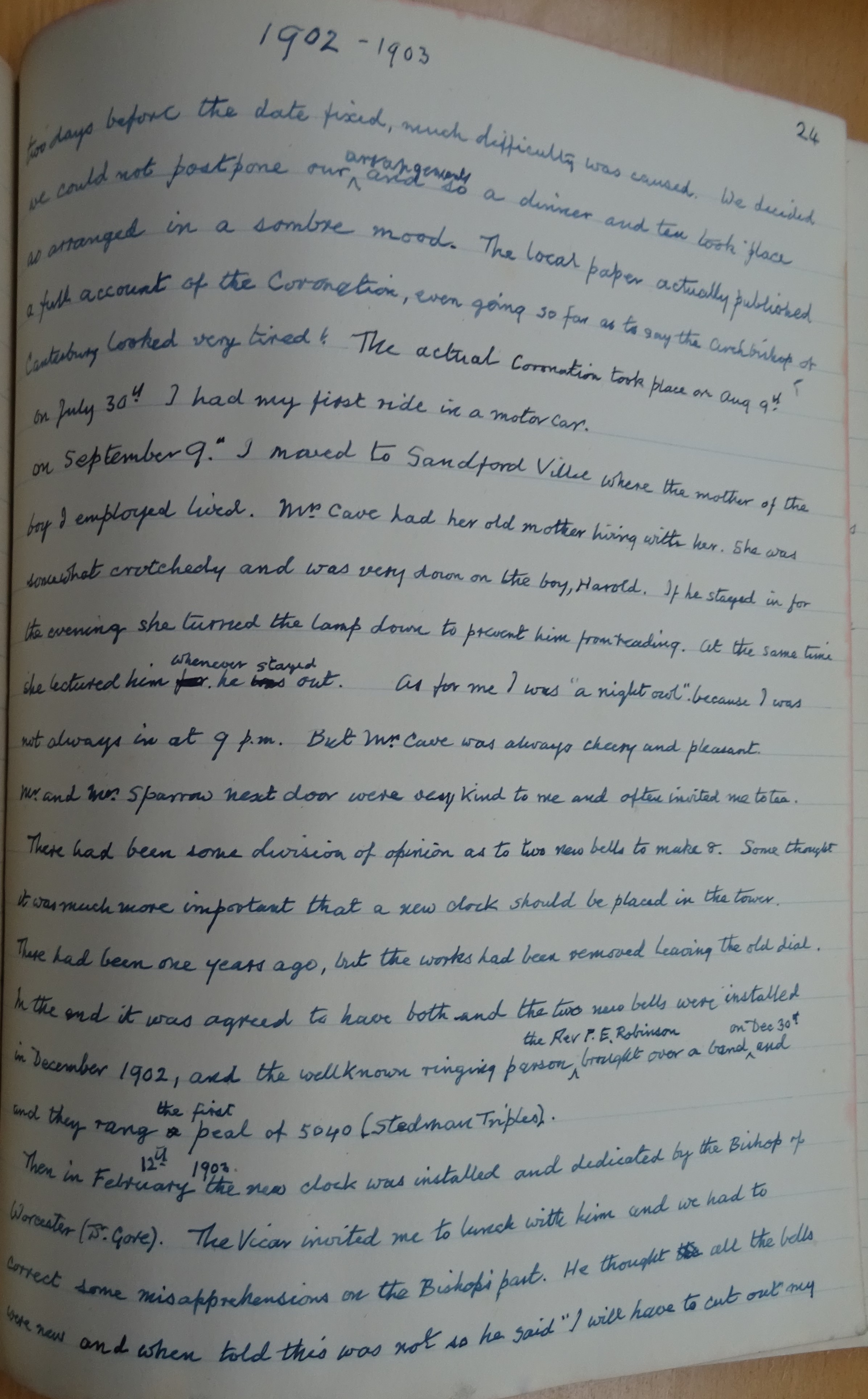
In June the coronation of Edward VII was to have taken place, but his sudden illness caused it to be postponed. As this took place only two days before the date fixed, much difficulty was caused. We decided we could not postpone our arrangements and so a dinner and tea took place as arranged in a sombre mood. The local paper actually published a full account of the Coronation, even going so far as to say the Archbishop of Canterbury looked very tired! The actual coronation took place on Aug 9th. But the children had a tea and were given mugs to commemorate the event. On the actual Coronation day, there was a service at 11 with ringing. I gave a firework display in the Stockey. I was rather worried by a tipsy man who wanted to help.
On July 30th I had my first ride in a motor car.
On September 9th I moved to Sandford Villa where the mother of the boy I employed lived. Mrs Cave had her old mother living with her. She was somewhat crotchety and was very down on the boy, Harold. If he stayed in for the evening she turned the lamp down to prevent him from reading. At the same time she lectured him whenever he stayed out. As for me I was a “night owl” because I was not always in at 9 pm. But Mrs Cave was always cheery and pleasant. Mr & Mrs Sparrow next door were very kind to me and often invited me to tea.
There had been some division of opinion as to the two new bells to make eight. Some thought it was much more important that a new clock should be placed in the tower. There had been one years ago, but the works had been removed leaving the old dial. In the end it was agreed to have both and the two new bells were installed in December 1902, and the well known ringing person, the Rev P E Robinson, brought over a band on Dec 30th and they rang the first peal of 5040 (Stedmore Triples).
1903
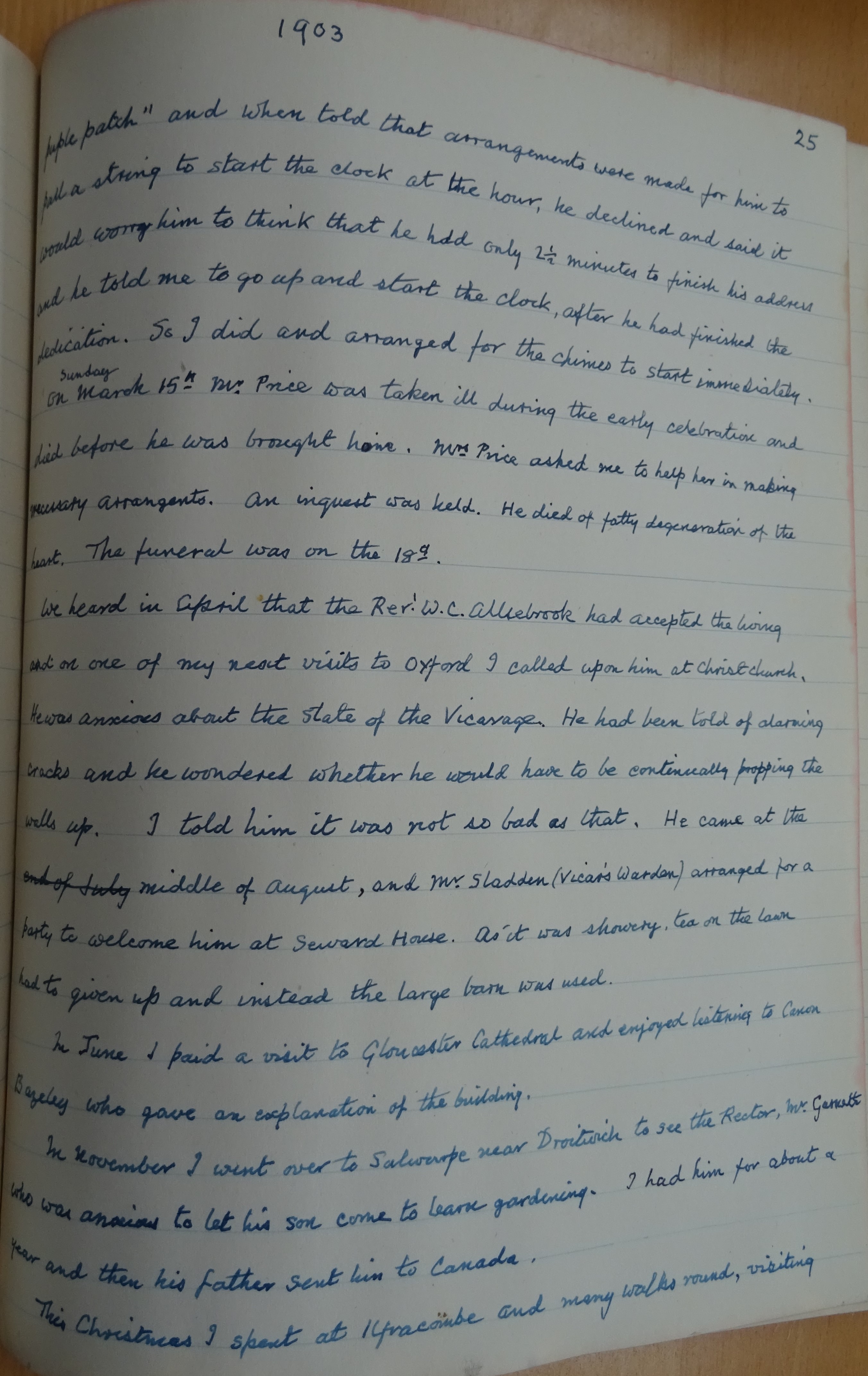
Then on February 12th 1903 the new clock was installed and dedicated by the Bishop of Worcester (Dr Gore). The Vicar invited me to lunch with him and we had to correct some misapprehensions on the Bishop’s part. He thought all the bells were new and when told this was not so he said, “I will have to cut out my purple patch” and when told that arrangements were made for him to pull a string to start the clock at the hour, he declined and said it would worry him to think that he had only 2½ minutes to finish his address and he told me to go up and start the clock, after he had finished the dedication. So I did and arranged for the chimes to start immediately.
I spent some time with the men erecting the clock and learned much about it – clock cost £128. Having started the clock, I have looked after it ever since with the help of various boys and men to do the winding.
On Sunday March 15th Mr Price was taken ill during the early celebration and died before he was brought home. Mrs Price asked me to help her in making necessary arrangements. An inquest was held. He died of fatty degeneration of the heart. The funeral was on the 18th.
We heard in April that the Reverend W C Allsebrook had accepted the living and on one of my next visits to Oxford I called upon him at Christ Church. He was anxious about the state of the Vicarage. He had been told of alarming cracks and he wondered whether he would have to be continually propping the walls up. I told him it was not so bad as that. He came at the middle of August, and Mr Sladden (Vicar’s Warden) arranged for a party to welcome him at Seward House. As it was showery, tea on the lawn had to be given up and instead the large barn was used.
In June I paid a visit to Gloucester Cathedral and enjoyed listening to Canon Bazeley who gave an explanation of the building.
In November I went over to Salwarpe near Droitwich to see the Rector Mr Garnett, who was anxious to let his son come to learn gardening. I had him for about a year and then his father sent him to Canada.
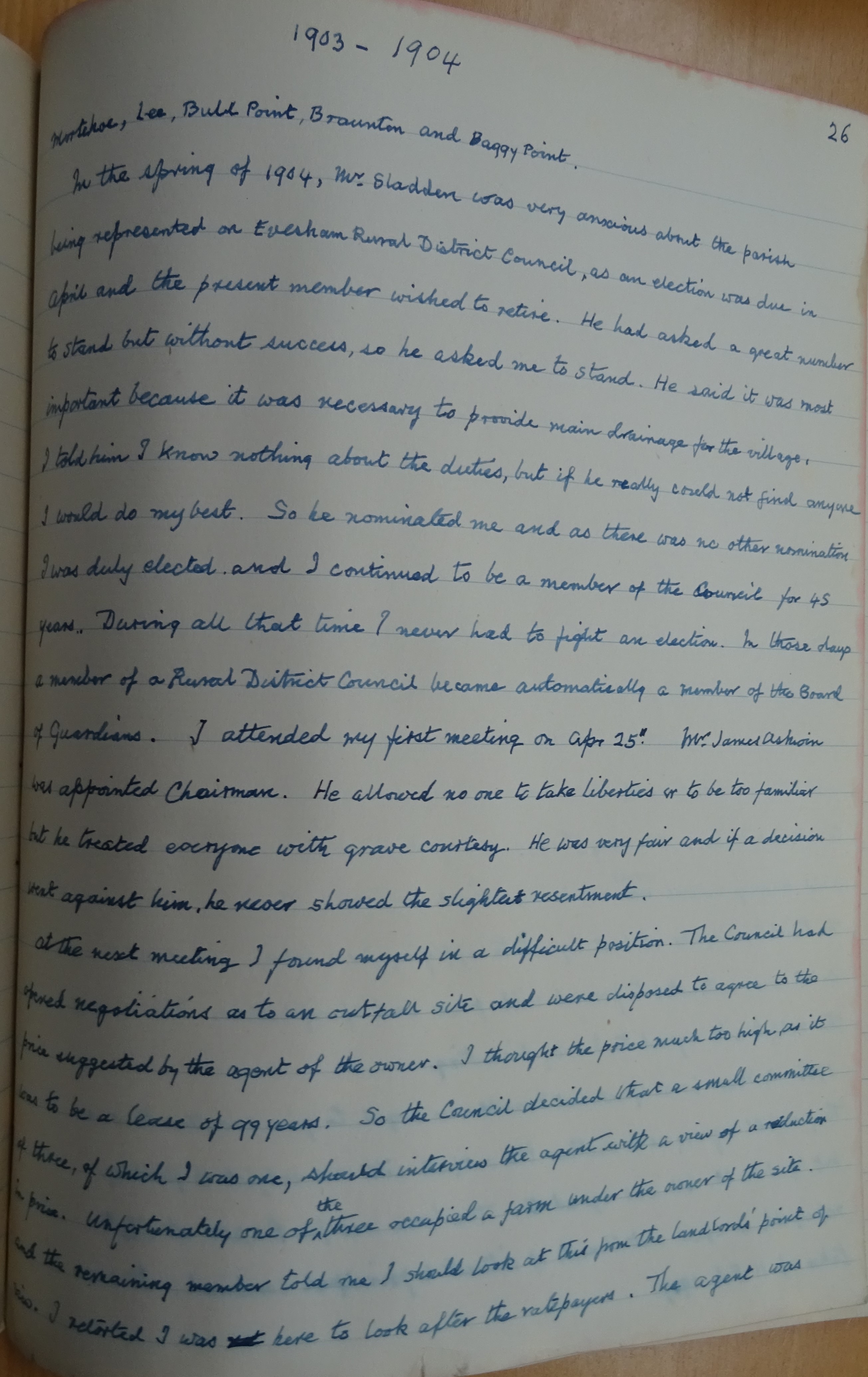
This Christmas I spent at Ilfracombe and many walks round, visiting Northoe, Lee, Buld Point and Baggy Point.
1904
In the spring of 1904, Mr Sladden was very anxious about the parish being represented on Evesham Rural District council, as an election was due in April and the present member wished to retire. He had asked a great number to stand but without success, so he asked me to stand. He said it was most important because it was necessary to provide main drainage for the village. I told him I know nothing about the duties, but if he really could not find anyone I would do my best. The Vicar was asked to stand but refused. The Clerk (Joseph Agg) said, “It is just as well because whoever had taken on the job had always lost whatever reputation he had.” Not very encouraging for me!
So he nominated me and as there was no other nomination I was duly elected and I continued to be a member of the Council for 45 years. During all that time I never had to fight an election. In those days a member of a Rural District Council became automatically a member of the Board of Guardians. I attended my first meeting on April 25th. Mr James Ashwin was appointed Chairman. He allowed no one to take liberties or to be too familiar but he treated everyone with grave courtesy. He was very fair and if a decision went against him, he never showed the slightest resentment.
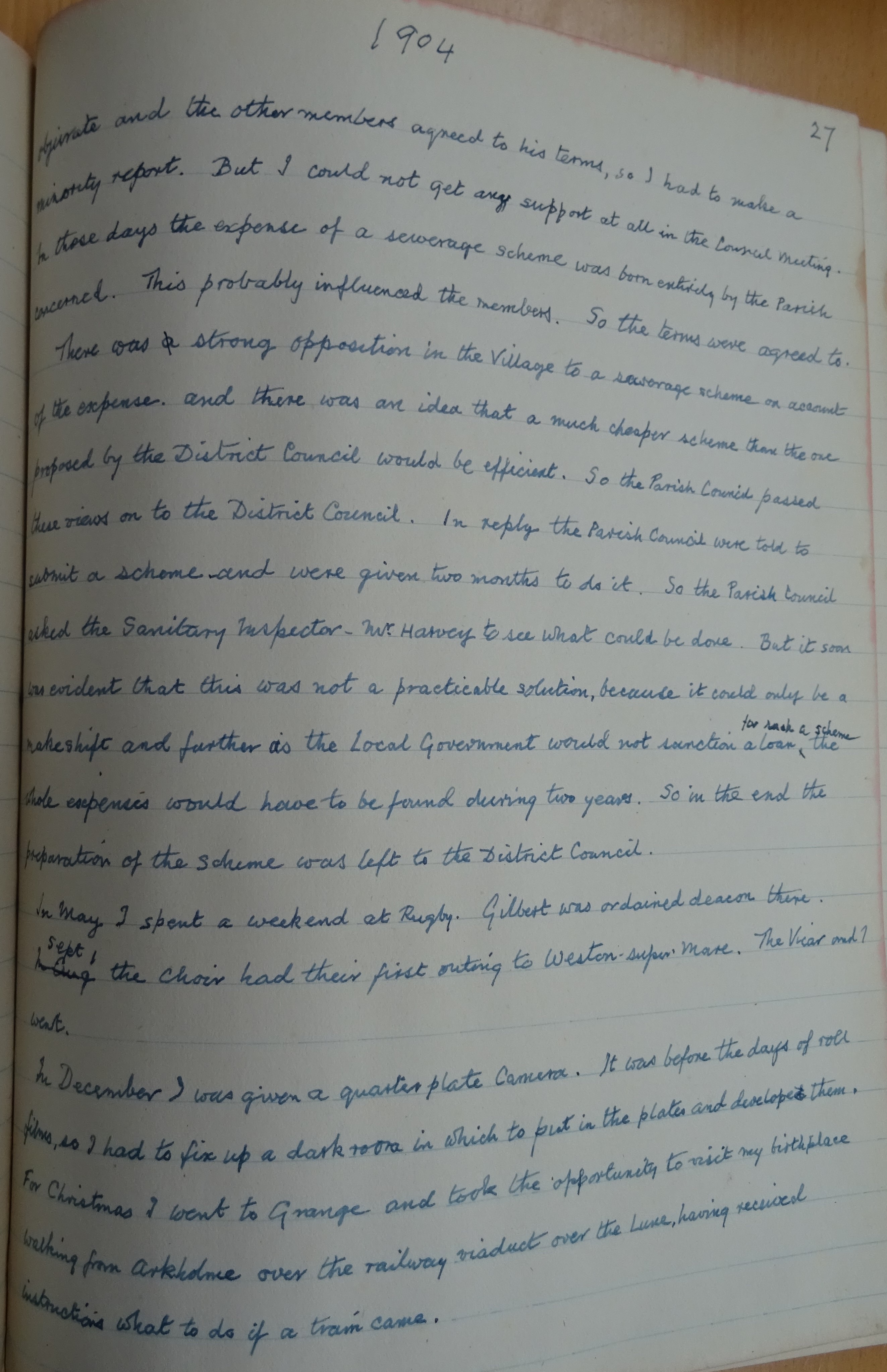
At the next meeting I found myself in a difficult position. The Council had opened negotiations as to an outfall site and were disposed to agree to the price suggested by the agent of the owner. I thought the price much too high as it was to be a lease of 99 years. So the Council decided that a small Committee of three, of which I was one, should interview the agent with a view of a reduction in price. Unfortunately one of the three occupied a farm under the owner of the site and the remaining member told me I should look at this from the landlord’s point of view. I retorted I was here to look after the ratepayers. The agent was obdurate and the other members agreed to his terms, so I had to make a minority report. But I could not get any support at all in the Council meeting. In three days the expense of a sewerage scheme was born entirely by the Parish Council. This probably influenced the members. So the terms were agreed to.
There was strong opposition in the village to a sewerage scheme on account of the expense and there was an idea that a much cheaper scheme than the one proposed by the District Council would be efficient. So the Parish Council passed these views on to the District Council. In reply the Parish Council were told to submit a scheme and were given two months to do it. So the Parish Council asked the Sanitary Inspector, Mr Harvey, to see what could be done. But it soon was evident that this was not a practicable solution, because it could only be a makeshift and further as the Local Government would not sanction a loan for such a scheme, the whole expenses would have to be found during two years. So in the end the preparation of the scheme was left to the District Council.
In May I spent a weekend at Rugby. Gilbert was ordained deacon there.
Sept 1 the choir had their first outing to Weston-super-Mare. The Vicar and I went.
In December I was given a quarter plate camera. It was before the days of roll film, so I had to fix up a dark room in which to put in the plates and develop them.
For Christmas I went to Grange and took the opportunity to visit my birthplace, walking from Arkledene over the railway viaduct over the Lune, having received instructions what to do if a train came.
1904-1907
It happened that Broadway was being supplied with a similar scheme. As they were ready to begin, I had an opportunity to learn something about the procedure.
It was a long time before the Badsey Scheme took shape. The Parish Council wished it to be done in sections so as to spread the coast over several years. A sub-committee of the RDC was appointed to meet the Parish Council with the County Medical Officer Health, Dr Fosbroke. It was agreed to submit the proposal to Willcox & Raikes. On July 3rd 1905 a report from them was received. They said Harvey’s scheme would not be sanctioned for loan. Their report was sent to the Parish Council, who at last agreed to applying for a loan. On Aug 28 1905 W & R were instructed to proceed with plans and specifications. The cost of the outfall site agreed to, I only dissenting.
1906 12 Mar, Local Government Boards were urged to give sanction to loan. They raised a query as to whether the outfall site was subject to flooding, but by June 30, all was agreed to. The loan was for £2,200 at 3¾% repayable in equal instalments of interest and principal combined. It was taken up 11 Feb 1907.
1905
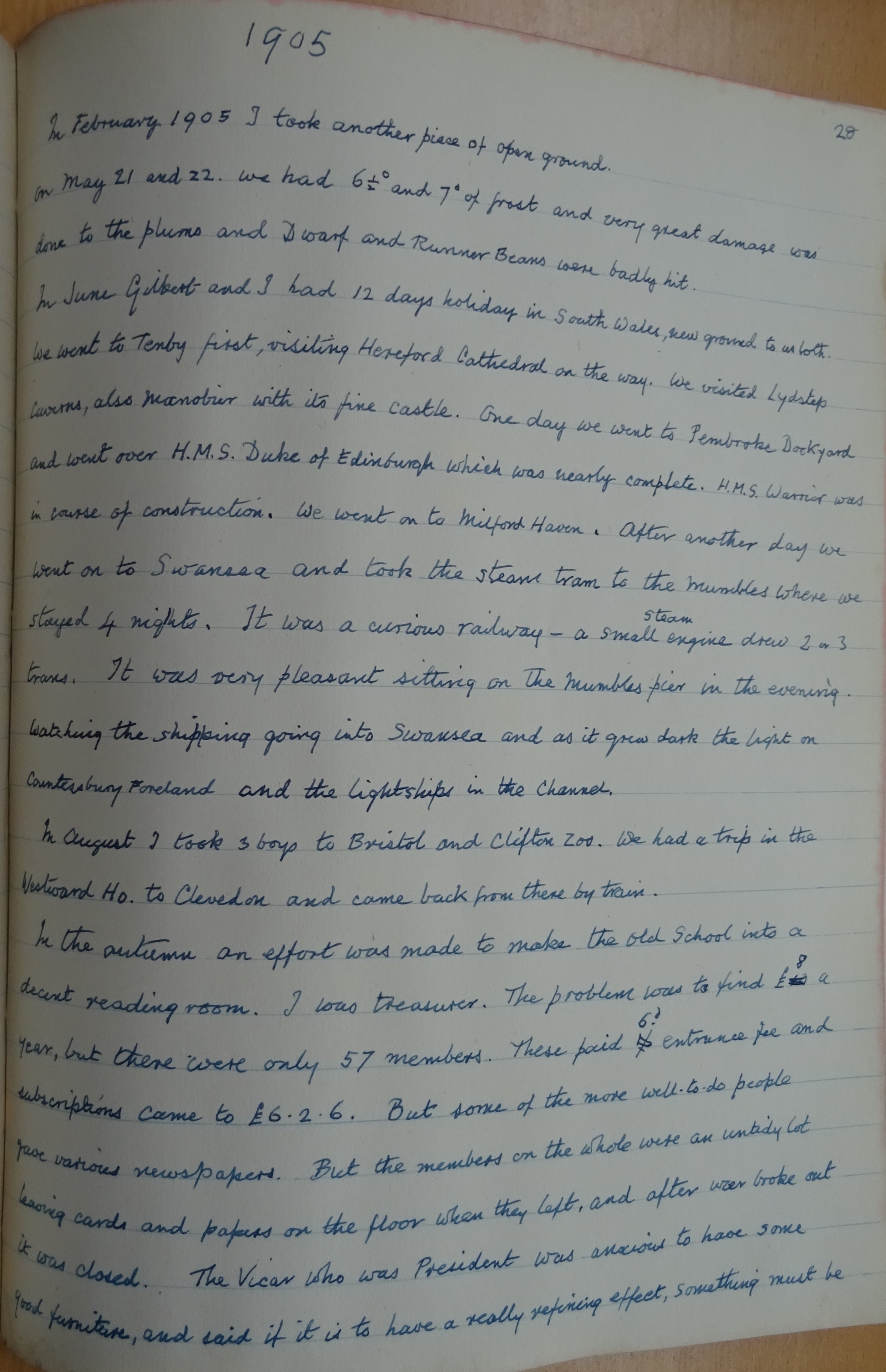
In February 1905 I took another piece of open ground.
On May 21 and 22 we had 6½o and 7o of frost and very great damage was done to the plums and Dwarf and Runner Beans were badly hit.
In June Gilbert and I had 12 days holiday in South Wales, new ground to us both. We went to Tenby first, visiting Hereford Cathedral on the way. We visited Lydstep Caverns, also Manobier with its fine castle. One day we went to Pembroke Dockyard and went over HMS Duke of Edinburgh which was nearly complete. HMS Warrior was in course of construction. We went on to Milford Haven. After another day we went on to Swansea and took the steam tram to the Mumbles where we stayed 4 nights. It was a curious railway - a small steam engine drew 2 or 3 trams. It was very pleasant sitting on the Mumbles pier in the evening watching the shipping going into Swansea and as it grew dark the light on Countesbury Foreland and the lightships in the Channel.
In August I took 3 boys to Bristol and Clifton Zoo. We had a trip in the Westward Ho to Cleveland and came back from there by train.
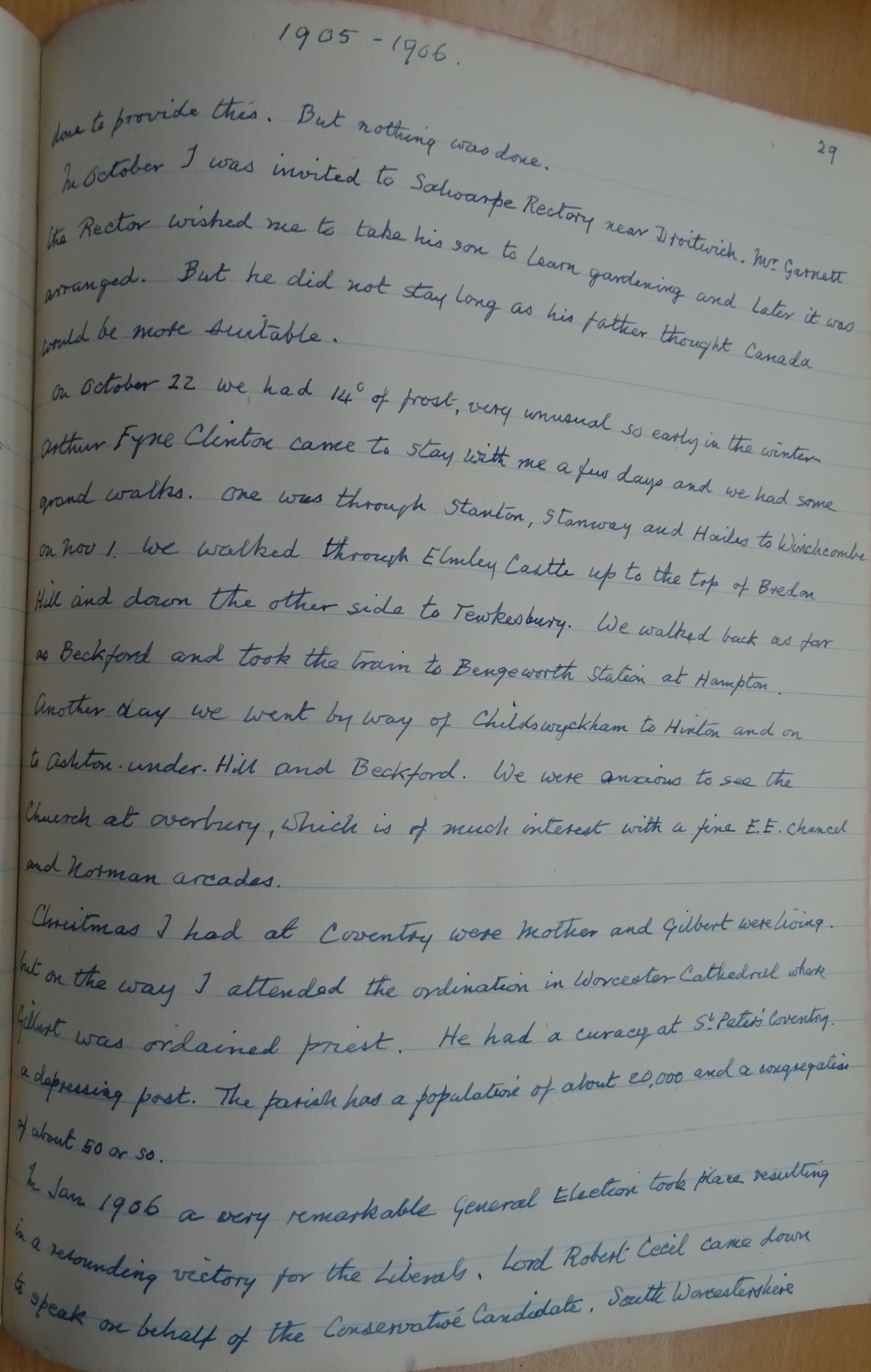
In the autumn an effort was made to make the Old School into a decent reading room. I was Treasurer. The problem was to find £8 a year, but there were only 57 members. These paid 6d entrance fee and subscriptions came to £6.2.6. But some of the more well-to-do people gave various newspapers. But the members on the whole were an untidy lot leaving cards and papers on the floor when they left, and after war broke out it was closed. The Vicar who was President was anxious to have some good furniture, and said if it is to have a really refining effect, something must be done to provide this. But nothing was done.
In October I was invited to Salwarpe Rectory near Droitwich. Mr Garnett, the Rector, wished me to take his son to learn gardening and later it was arranged. But he did not stay long as his father thought Canada would be more suitable.
On October 22 we had 14o of frost, very unusual so early in the winter. Arthur Fynes Clinton came to stay with me a few days and we had some grand walks. One was through Stanton, Stanway and Hailes to Winchcombe. On Nov 1 we walked through Elmley Castle up to the top of Bredon Hill and down the other side to Tewkesbury. We walked back as far as Beckford and took the train to Bengeworth Station at Hampton. Another day we went by way of Childswyckham to Hinton and on to Ashton-under-Hill and Beckford. We were anxious to see the church at Overbury, which is of must interest with a fine Early English chancel and Norman arcades.
Christmas I had at Coventry where Mother and Gilbert were living, but on the way I attended the ordination in Worcester Cathedral where Gilbert was ordained priest. He had a curacy at St Peter’s, Coventry, a depressing post. The parish has a population of about 20,000 and a congregation of about 50 or so.
1906
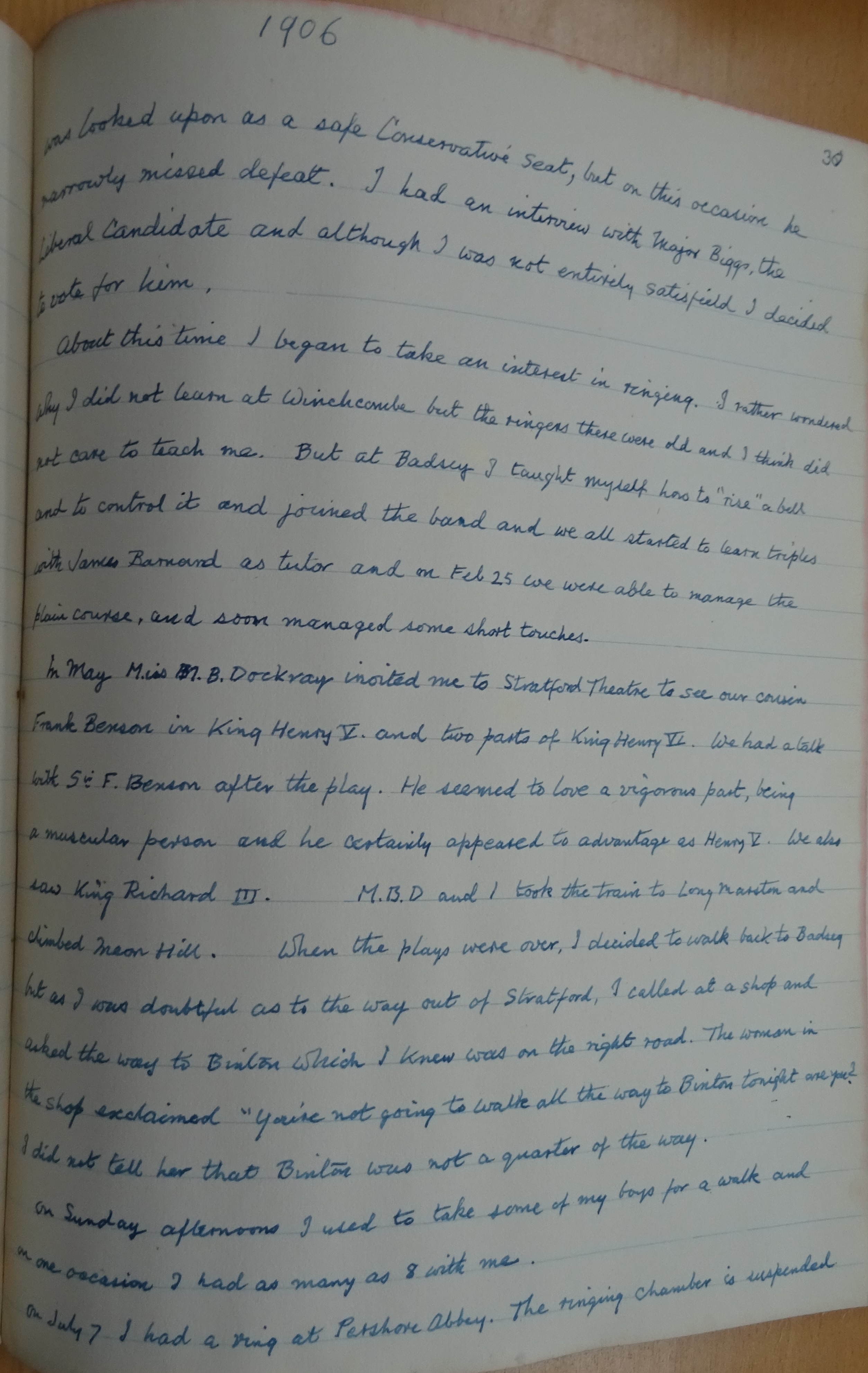
In Jan 1906 a very remarkable General Election took place resulting in a resounding victory for the Liberals. Lord Robert Cecil came down to speak on behalf of the Conservative candidate. South Worcestershire was looked upon as a safe Conservative seat, but on this occasion he narrowly missed defeat. I had an interview with Major Biggs, the Liberal candidate and although I was not entirely satisfied I decided to vote for him.
About this time I decided to take an interest in ringing. I rather wondered why I did not learn at Winchcombe but the ringers there were old and I think did not care to teach me. But at Badsey I taught myself how to “rise” a bell and to control it and joined the band and we all started to learn triples with James Barnard as tutor and on Feb 25 we were able to manage the plain course, and soon managed some short touches.
In May Miss M B Dockray invited me to Stratford Theatre to see our cousin Frank Benson in King Henry V and two parts of King Henry VI. We had a talk with Sir F Benson after the play. He seemed to love a vigorous part, being a muscular person and he certainly appeared to advantage as Henry V. We also saw King Richard III. MBD and I took the train to Long Marston and climbed Meon Hill. When the plays were over I decided to walk back to Badsey but as I was doubtful as to the way out of Stratford, I called at a shop and asked the way to Binton which I knew was on the right road. The woman in the shop exclaimed, “You’re not going to walk all the way to Binton tonight, are you?” I did not tell her that Binton was not a quarter of the way.
On Sunday afternoons I used to take some of my boys for a walk and on one occasion I had as many as 8 with me.
On July 7 I had a ring at Pershore Abbey. The ringing chamber is suspended in the middle of the Central Tower and by looking over the edge ….. [difficult to read].
On Aug 16th I went to Gloucester and then by coach to Sharpness. Then by train across the wide river to the other bank then I walked to [?]. A fine view from the churchyard to the great bend of the Severn. Back by train.
In September Gilbert and I were invited by MBD to have a fortnight at Abergavenny. The day after we arrived Gilbert and I ascended the Sugar Loaf and had a glorious view, we could pick out the Malverns and Bredon Hill. The next day we went on a large tramp on the Black Mountains and reached the highest point. No dwelling in sight for most of the way and we met no one. We came back and descended to the little hamlet of Patreis, where we found a very interesting old church with a wonderful ancient font. Gilbert became very tired and had a day in bed. We visited the Iron Works at Ebbw Vale and saw many interesting things. A few days after I went by myself by bus to Brecon and climbed the Brecon Beacon and came down to Dowlais where the housing conditions seemed shocking, and on to [?] Bridge.
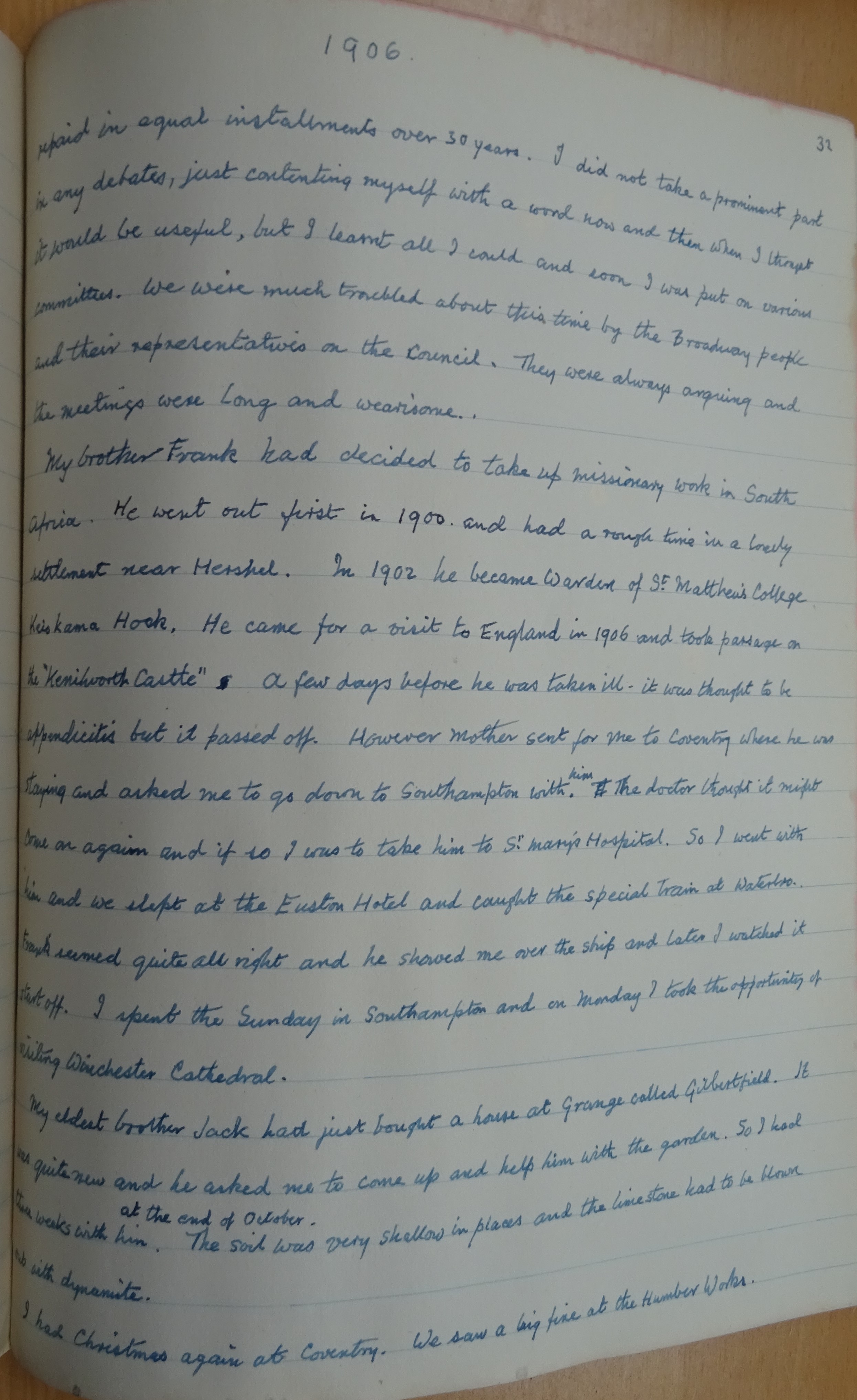
Meanwhile the RDC has at last decided on the Sewerage Scheme for Badsey and a loan for £2,200 was taken up. Interest was 3¾% to be repaid in equal instalments over 30 years. I did not take a prominent part in any debates, just contenting myself with a word now and then when I thought it would be useful, but I learnt all I could and soon I was put on various committees. We were much troubled about this time by the Broadway people and their representatives on the Council. They were always arguing and the meetings were long and wearisome.
My brother Frank had decided to take up missionary work in South Africa. H went out first in 1900 and had a rough time in a lonely settlement near Hershel. In 1902 he became Warden of St Matthew’s College, Keiskama Hook. He came for a visit to England in 1906 and took passage on the “Kenilworth Castle”. A few days before he was taken ill; it was thought to be appendicitis but it passed off. However Mother sent for me to Coventry where he was staying and asked me to go down to Southampton with him. The doctor thought it might come on again and if so I was to take him to St Mary’s Hospital. So I went with him and we slept at the Euston Hotel and caught the special train at Waterloo. Frank seemed quite all right and he showed me over the ship and later I watched it start off. I spent the Sunday in Southampton and on Monday I took the opportunity of visiting Winchester Cathedral.
My eldest brother Jack had just bought a house at Grange called Gilbertfield. It was quite new and he asked me to come up and help him with the garden. So I had three weeks with him at the end of October. The soil was very shallow in places and the limestone had to be blown out with dynamite.
I had Christmas again at Coventry. We saw a big fire at the Humber Works.
1907
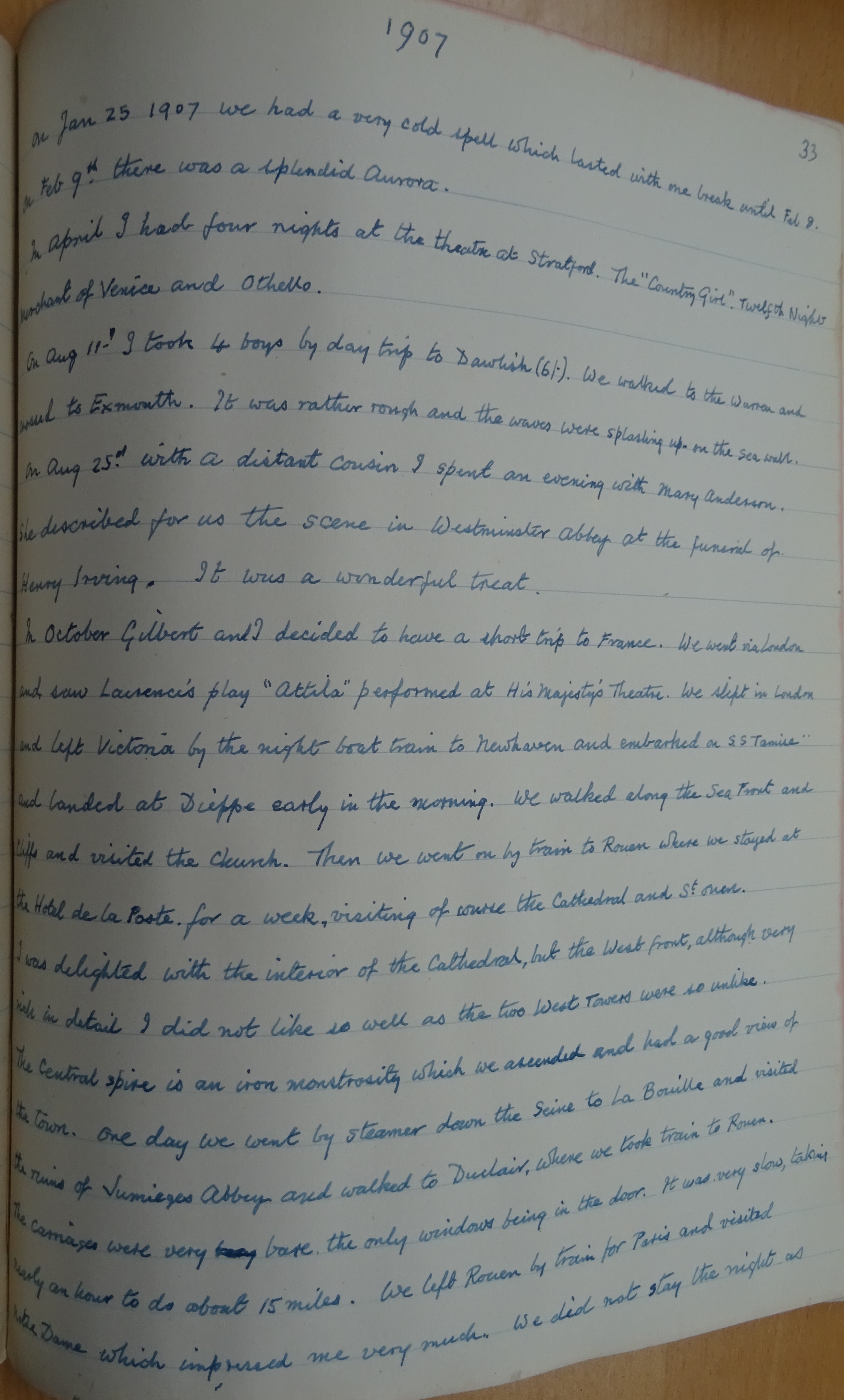
On Jan 25 1907 we had a very cold spell which lasted with one break until Feb 8. On Feb 9th there was a splendid Aurora.
In April I had four nights at the theatre at Stratford. The Country Girl, Twelfth Night, Merchant of Venice and Othello.
On Aug 11th I took 4 boys by day trip to Dawlish (6/-). We walked to the Warren and crossed to Exmouth. It was rather rough and the waves were splashing up on the sea wall.
On Aug 25th with a distant cousin I spent an evening with Mary Anderson. She described for us the scene in Westminster Abbey at the funeral of Henry Irving. It was a wonderful treat.
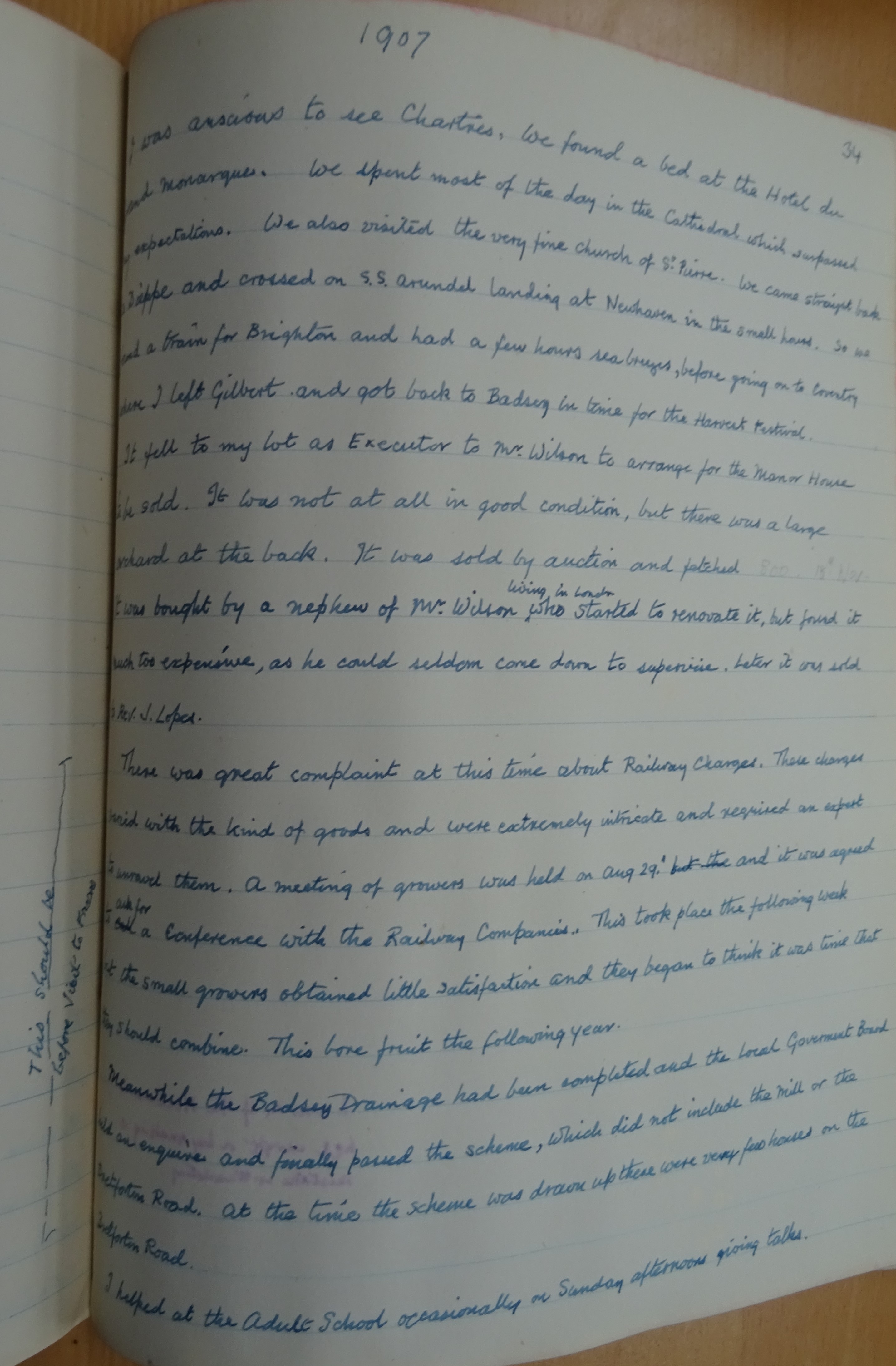
In October Gilbert and I decided to have a short trip to France. We went via London and saw Lawrence’s play “Attila” performed at His Majesty’s Theatre. We select in London and left Victoria by the night boat train to Newhaven and embarked on SS Tamara and landed at Dieppe early in the morning. We walked along the sea front and cliffs and visited the church. Then we went on by train to Rouen where we stayed at the Hotel de la Poste for a week, visiting of course the cathedral and St Omer. I was delighted with the interior of the cathedral, but the west front, although very rich in details, I did not like so well as the two west towers were so unlike. The central spire is an iron monstrosity which we ascended and had a good view of the town. One day we went by steamer down the Seine to La Bouille and visited the ruins of Jumieges Abbey and walked to Duclair, where we took train to Rouen. The carriages were very bare, the only windows being in the door. It was very slow, taking nearly an hour to do about 15 miles. We left Rouen by train for Paris and visited Norte Dame which impressed me very much. We did not stay the night as I was anxious to see Chartres. We found a bed at the Hotel du Grand Monarques. We spent most of the day in the cathedral which surpassed our expectations. We also visited the very fine church of St Pierre. We came straight back to Dieppe and crossed on SS Arundel landing at Newhaven in the small hours. So we found a train for Brighton and had a few hours sea breezes before going on to Coventry where I left Gilbert and got back to Badsey in time for the Harvest Festival.
It fell to my lot as Executor to Mr Wilson to arrange for the Manor House to be sold. It was not at all in good condition, but there was a large orchard at the back. It was sold by auction and fetched [800 faintly written in pencil 18th Nov]. It was bought by a nephew of Mr Wilson living in London who started to renovate it, but found it much too expensive, as he could seldom come down to supervise. Later it was sold to Rev J Lopes.
There was great complaint at this time about railway charges. These charges tried with the kind of goods and were extremely intricate and required an expert to unravel them. A meeting of growers was held on Aug 29th and it was agreed to ask for a conference with the Railway Companies. This took place the following week but the small growers obtained little satisfaction and they bean to think it was time that they should combine. This bore fruit the following year.
Meanwhile the Badsey Drainage had been completed and the Local Government Board held an enquiry and finally passed the scheme, which did not include the Mill or the Bretforton Road. At the time the scheme was drawn up there were very few houses on the Bretforton Road.
[There is a note in the notebook saying “This should be before visit to France” – the area highlighted was the last two paragraphs.]
I helped at the Adult School occasionally on Sunday afternoons giving talks.
1908
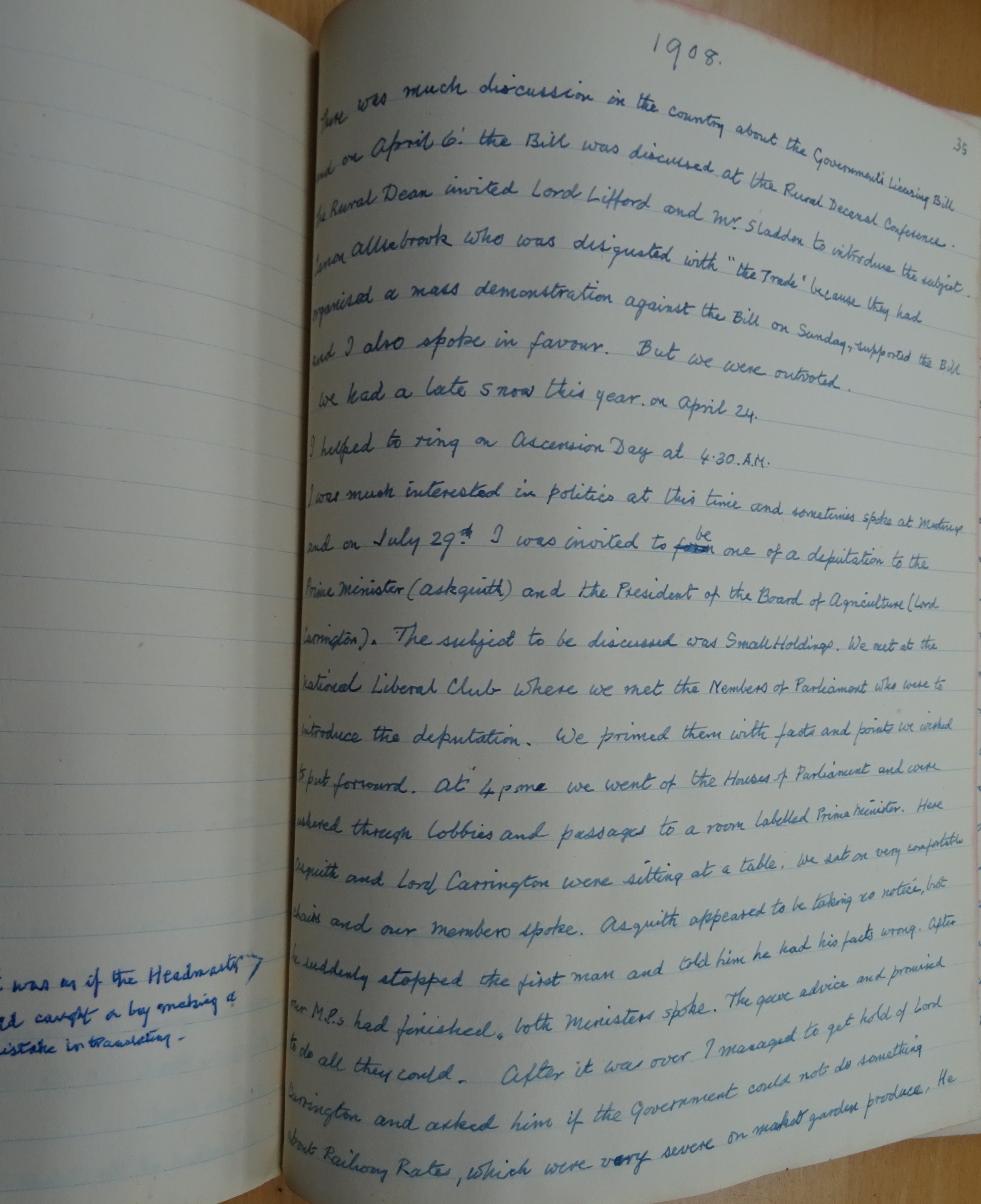
There was much discussion in the country about the Government’s Licensing Bill and on April 6 the Bill was discussed at the Rural Decanal Conference. The Rural Dean invited Lord Lifford and Mr Sladden to introduce the subject. Canon Allsebrook, who was disgusted with “the Trade” because they had organised a mass demonstration against the Bill on Sunday, supported the Bill and I also spoke in favour. But we were outvoted.
We had a late snow this year on April 24.
I helped to ring on Ascension Day at 4.30 am.
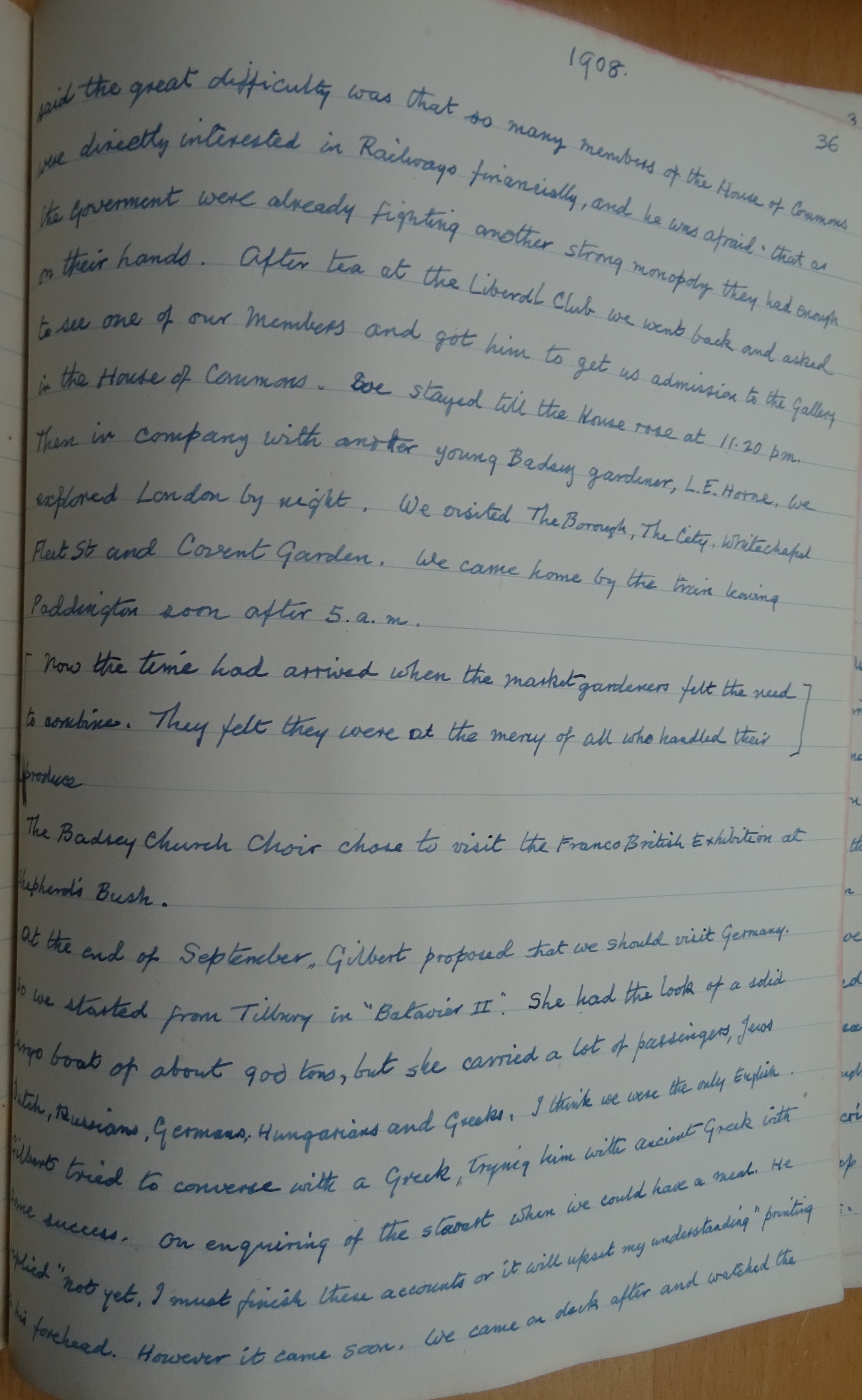
I was much interested in politics at this time and sometimes spoke at meetings and on July 29th I was invited to be one of a deputation to the Prime Minister (Asquith) and the President of the Board of Agriculture (Lord Carrington). The subject to be discussed was Small Holdings. We met at the National Liberal Club where we met the Members of Parliament who were to introduce the deputation. We primed them with facts and points we wished to put forward. At 4 pm we went to the Houses of Parliament and were ushered through lobbies and passages to a room labelled Prime Minister. Here Asquith and Lord Carrington were sitting at a table. We sat on very comfortable chairs and our members spoke. Asquith appeared to be taking no notice, but he suddenly stopped the first man and told him he had his facts wrong. [“It was as if the Headmaster had caught a boy making a mistake in translating” – this sentence was added in at this point.] After our MPs had finished, both Ministers spoke. They gave advice and promised to do all they could. After it was over I managed to get hold of Lord Carrington and asked him if the Government could not do something about Railway Rates, which were very severe on market garden produce. He said the great difficulty was that so many members of the House of Commons were directly interested in railways financially, and he was afraid that as the Government were already fighting another strong monopoly they had enough on their hands.
After tea at the Liberal Club we went back and asked to see one of our members and got him to get us admission to the Gallery in the House of Commons. We stayed till the House rose at 11.20 pm. Then in company with another young Badsey gardener, L E Horne, we explored London by night. We visited the Borough, the City, Whitechapel, Fleet Street and Covent Garden. We came home by the train leaving Paddington soon after 5 am.
Now the time had arrived when the market gardeners felt the need to combine. They felt they were at the mercy of all who handled their produce.
The Badsey Church Choir chose to visit the Franco British Exhibition at Shepherd’s Bush.
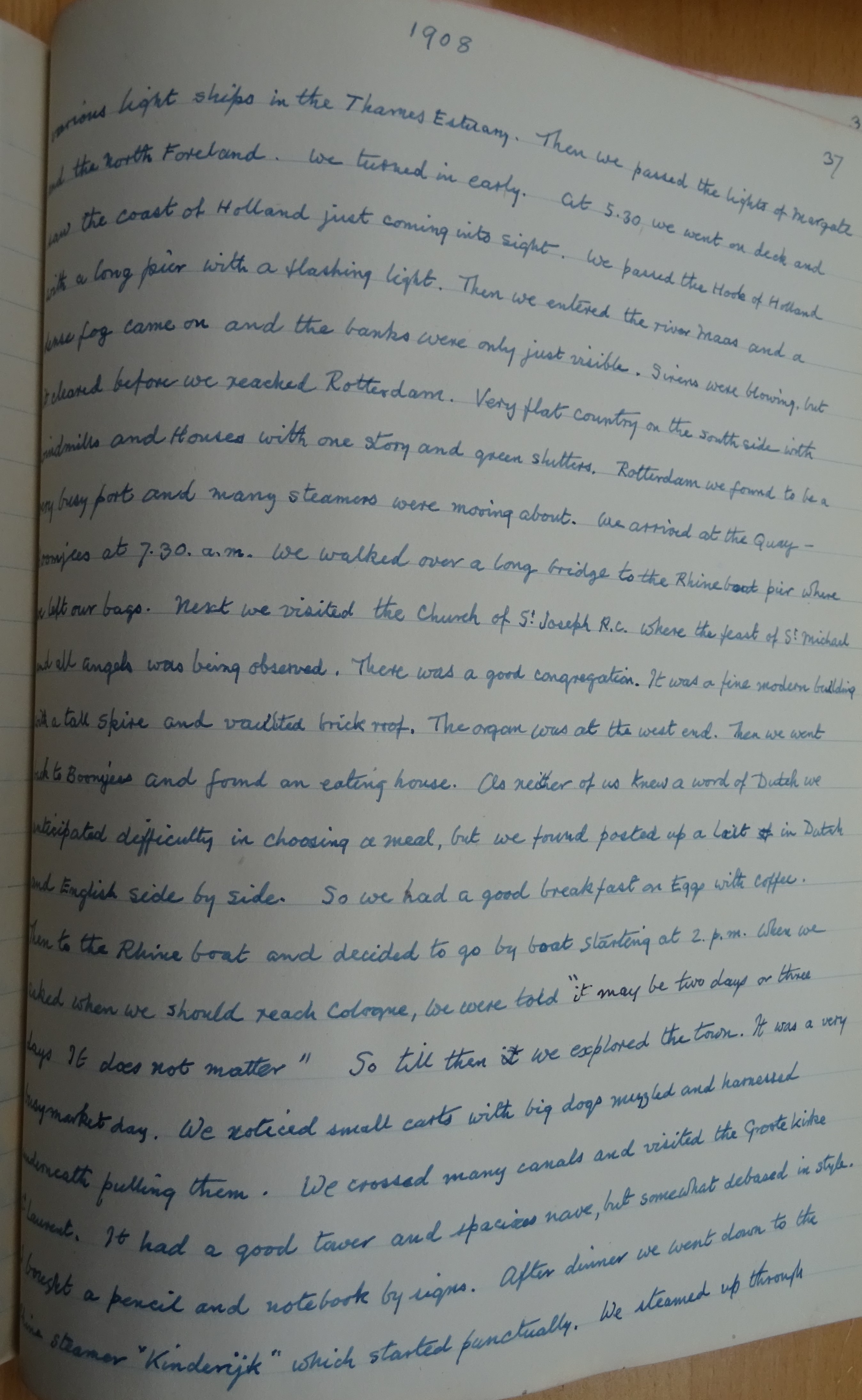
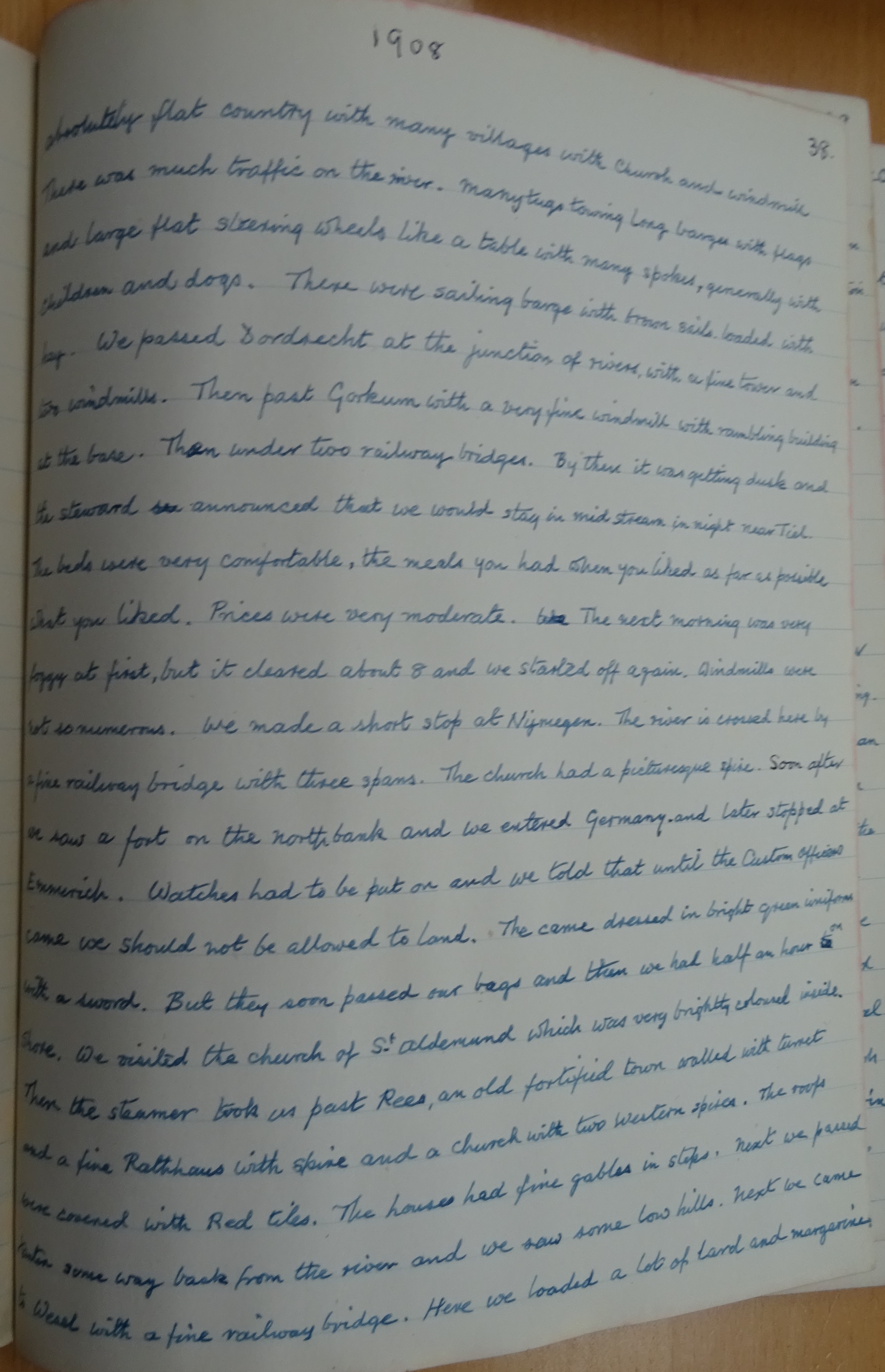
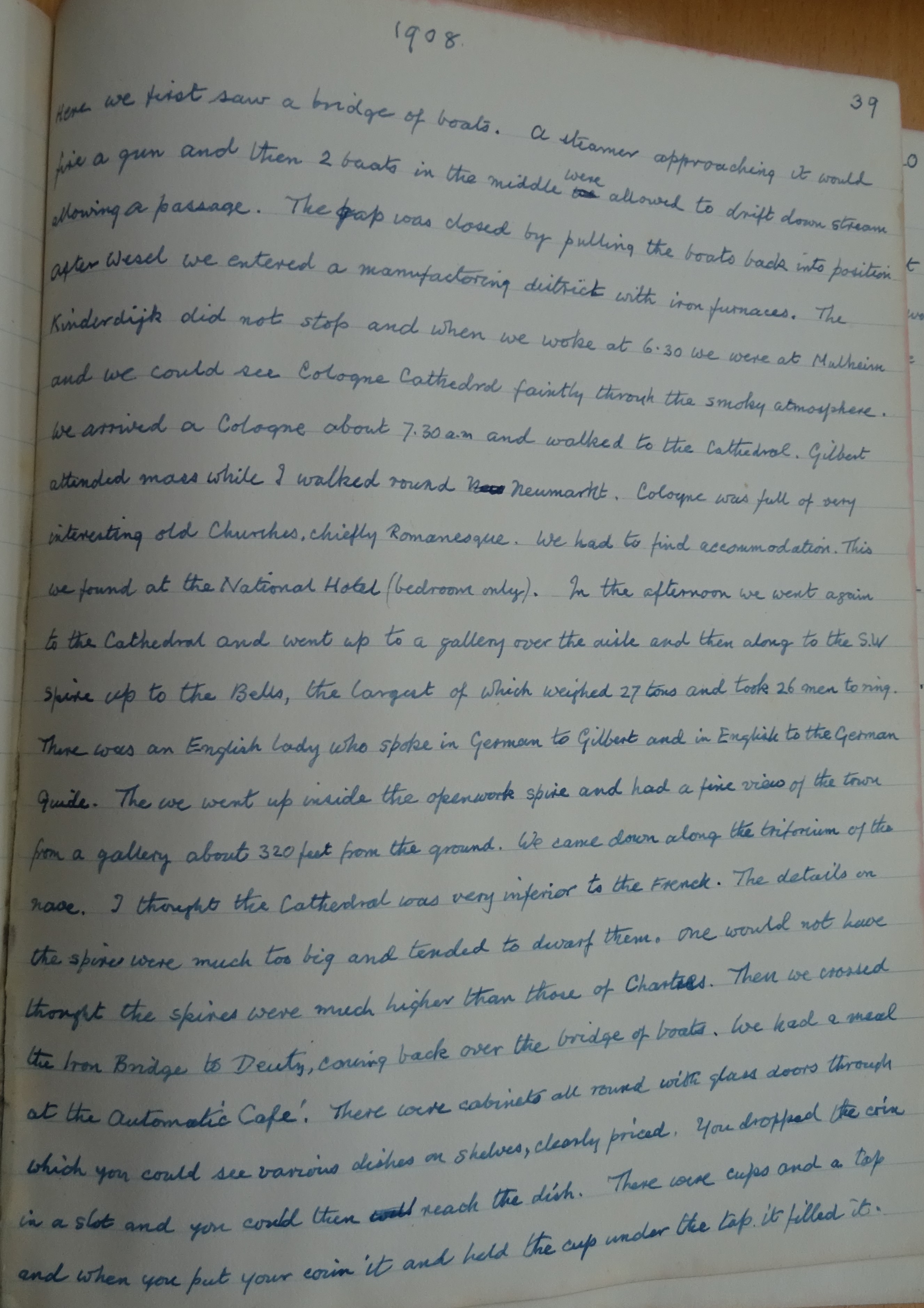
At the end of September, Gilbert proposed that we should visit Germany, so we started from Tilbury in “Batavier II”. She had the look of a solid cargo boat of about 900 tons, but she carried a lot of passengers, Jews, Dutch, Russians, Germans, Hungarians and Greeks. I think we were the only English. Gilbert tried to converse with a Greek, trying him with Ancient Greek with some success. On enquiringly of the steward when we could have a meal, he replied, “Not yet, I must finish these accounts or it will upset my understanding”, pointing to his forehead. However it came soon. We came on deck after and watched the various light ships in the Thames Estuary. Then we passed the lights of Margate and the North Foreland. We turned in early. At 5.30 we went on deck and saw the coast of Holland just coming into sight. We passed the Hook of Holland with a long pier with a flashing light. Then we entered the River Maas and a dense fog came on and the banks were only just visible. Sirens were blowing but it cleared before we reached Rotterdam. Very flat country on the south side with windmills and houses with one storey and green shutters. Rotterdam we found to be a very busy port and many steamers were moving about. We arrived at the Quay Boonyers at 7.30 am. We walked over a long bridge to the Rhine boat pier where we left our bags. Next we visited the church of St Joseph RC where the Feast of St Michael and All Angels was being observed. There was a good congregation. It was a fine modern building with a tall spire and vaulted brick roof. The organ was at the west end. Then we went back to Boonyers and found an eating house. As neither of us knew a word of Dutch we anticipated difficulty in choosing a meal, but we found posted up a list in Dutch and English side by side. So we had a good breakfast on eggs with coffee. Then to the Rhine boat and decided to go by boat starting at 2 pm. When we asked when we should reach Cologne, we were told “it may be two days or three days, it does not matter.” So till then we explored the town. It was a very busy market day. We noticed small carts with big dogs muzzled and harnessed underneath pulling them. We crossed many canals and visited the Grootekirke St Laurent. It had a good tower and spacious nave, but somewhat debased in style. I bought a pencil and notebook by signs. After dinner we went down to the Rhine steamer “Kinderdijk” which started punctually. We steamed up through absolutely flat country with many villages with church and windmill. There was much traffic on the river. Many tugs towing long barges with flags and large flat steering wheels like a table with man spokes, generally with children and dogs. There were sailing barges with brown sails loaded with hay. We passed Dordrecht at the junction of rivers, with a fine tower and two windmills. Then past Gorkum with a very fine windmill with rambling building at the base. Then under two railway bridges. By then it was getting dusk and the steward announced that we would stay in mid stream in night near Tiel. The beds were very comfortable the meals you had when you liked, as far as possible what you liked. Prices were very moderate. The next morning was very foggy at first, but it cleared about 8 and we started off again. Windmills were not so numerous. We made a short stop at Nijmegen. The river is crossed here by a fine railway bridge with three spans. The church had a picturesque spire. Soon after we saw a fort on the north bank and we entered Germany and later stopped at Emmerich. Watches had to be put on and we told that until the Custom Officers came we should not be allowed to land. They came dressed in bright green uniform with a sword. But they soon passed our bags and then we had half an hour on shore. We visited the church of St Aldemund which was very brightly coloured inside. Then the steamer took us past Rees, an old fortified town walled with turret and a fine Rathaus with spire and a church with two western spires. The roofs were covered with red tiles. The houses had fine gables in steps. Next we passed [?] some way back from the river and we saw some low hills. Next we came to Wesel with a fine railway bridge. Here we loaded a lot of lard and margarine. Here we first saw a bridge of boats. A steamer approaching it would fire a gun and then 2 boats in the middle were allowed to drift downstream allowing a passage. The gap was closed by pulling the boats back into position.
After Wesel we entered a manufacturing district with iron furnaces. The Kinderdijk did not stop and when we woke at 6.30 we were at Malheim and we could see Cologne Cathedral faintly through the smoky atmosphere.
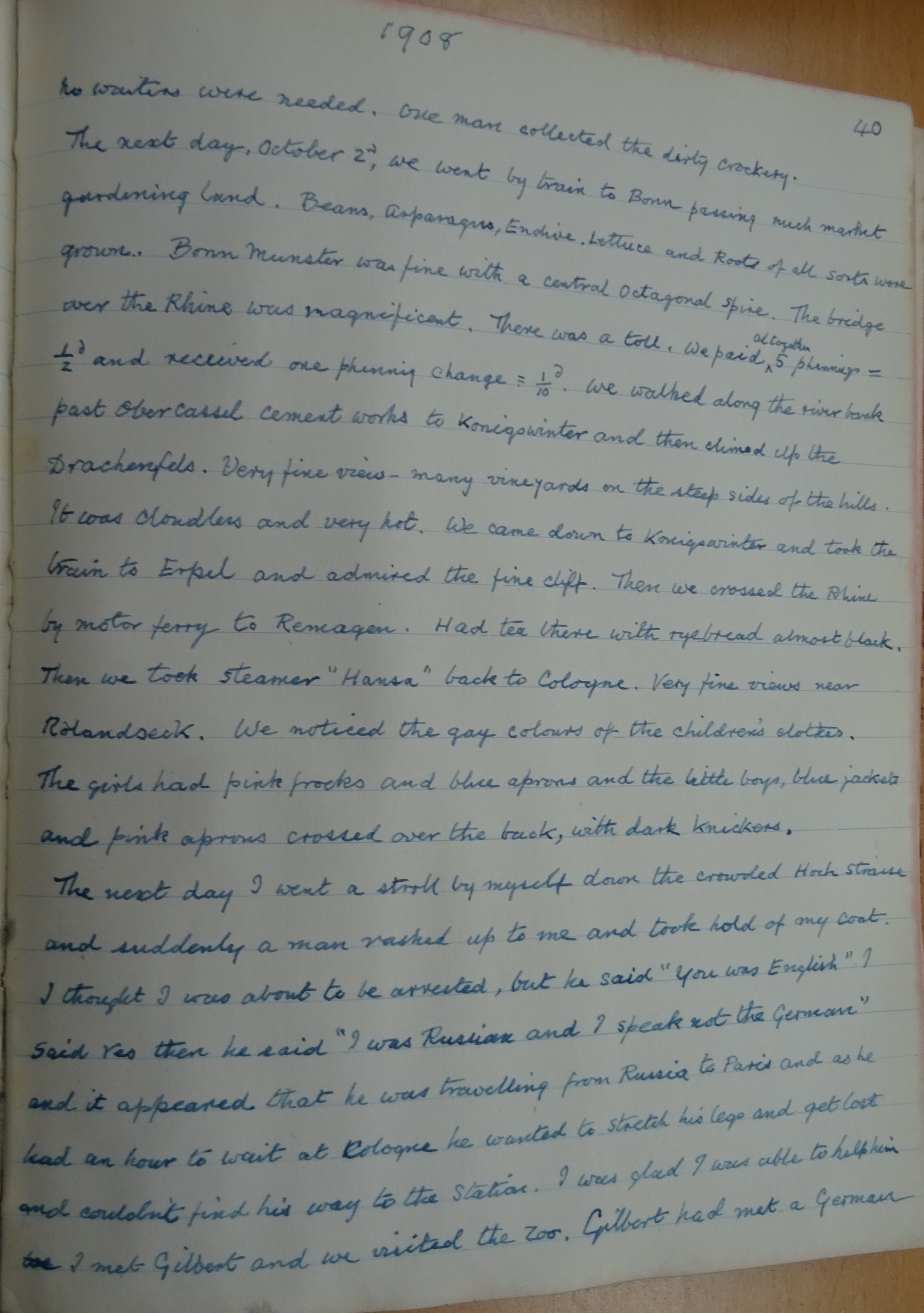
We arrived at Cologne about 7.30 am and walked to the cathedral. Gilbert attended mass while I walked round Neumarkt. Cologne was full of very interesting old churches, chiefly Romanesque. We had to find accommodation. This we found at the National Hotel (bedroom only). In the afternoon we went again to the cathedral and went up to a gallery over the aisle and then along to the SW spire up to the bells, the largest of which weighed 27 tons and took 26 men to ring. There was an English lady who spoke in German to Gilbert and in English to the German guide. Then we went up inside the openwork spire and had a fine view of the town from a gallery about 320 feet from the ground. We came down along the trifoliate of the nave. I thought the cathedral was very inferior to the French. The details on the spire were much too big and tended to dwarf them. One would not have thought the spires were much higher than those of Chartres. Then we crossed the Iron Bridge to Deutz, coming back over the Bridge of Boats. We had a meal at the Automatic Cafe. There were cabinets all round with glass doors through which you could see various dishes on shelves, clearly priced. You dropped the coin in a slot and you could then reach the dish. There were cups and a tap and when you put your coin in and held the cup under the tap it filled it. No waiters were needed. One more collected the dirty crockery.
The next day, October 2nd, we went by train to Bonn passing much market gardening land. Beans, asparagus, endive, lettuce and roots of all sorts were grown. Bonn Munster was fine with a central octagonal spire. The bridge over the Rhine was magnificent. There was a toll. We paid altogether 5 pfennigs = 1/2d and received one pfennig change - 1/10d. We walked along the river bank past Obercassel Cement Works to Konigwinter and then climbed up the Drachenfels. Very fine views - many vineyards on the steep sides of the hills. It was cloudless and very hot. We came down to Konigswinter and took the train to Erpel and admired the fine cliff. There we crossed the Rhine by motor ferry to Remegin. Had tea there with rye bread almost black. Then we took steamer “Hansa” back to Cologne. Very fine views near Rolandseck. We noticed the gay colours of the children’s clothes. The girls had pink frocks and blue aprons and the little boys, blue jackets and pink aprons crossed over the back, with dark knickers.
The next day I went a stroll by myself down the crowded Hock Strasse and suddenly a man rushed up to me and took hold of my coat. I thought I was about to be arrested, but he said, “You was English?” I said yes then he said, “I was Russian and I speak not the German” and it appeared that he was travelling from Russia to Paris and as he had an hour to wait at Cologne he wanted to stretch his legs and got lost and couldn’t find his way to the station. I was glad I was able to help him.
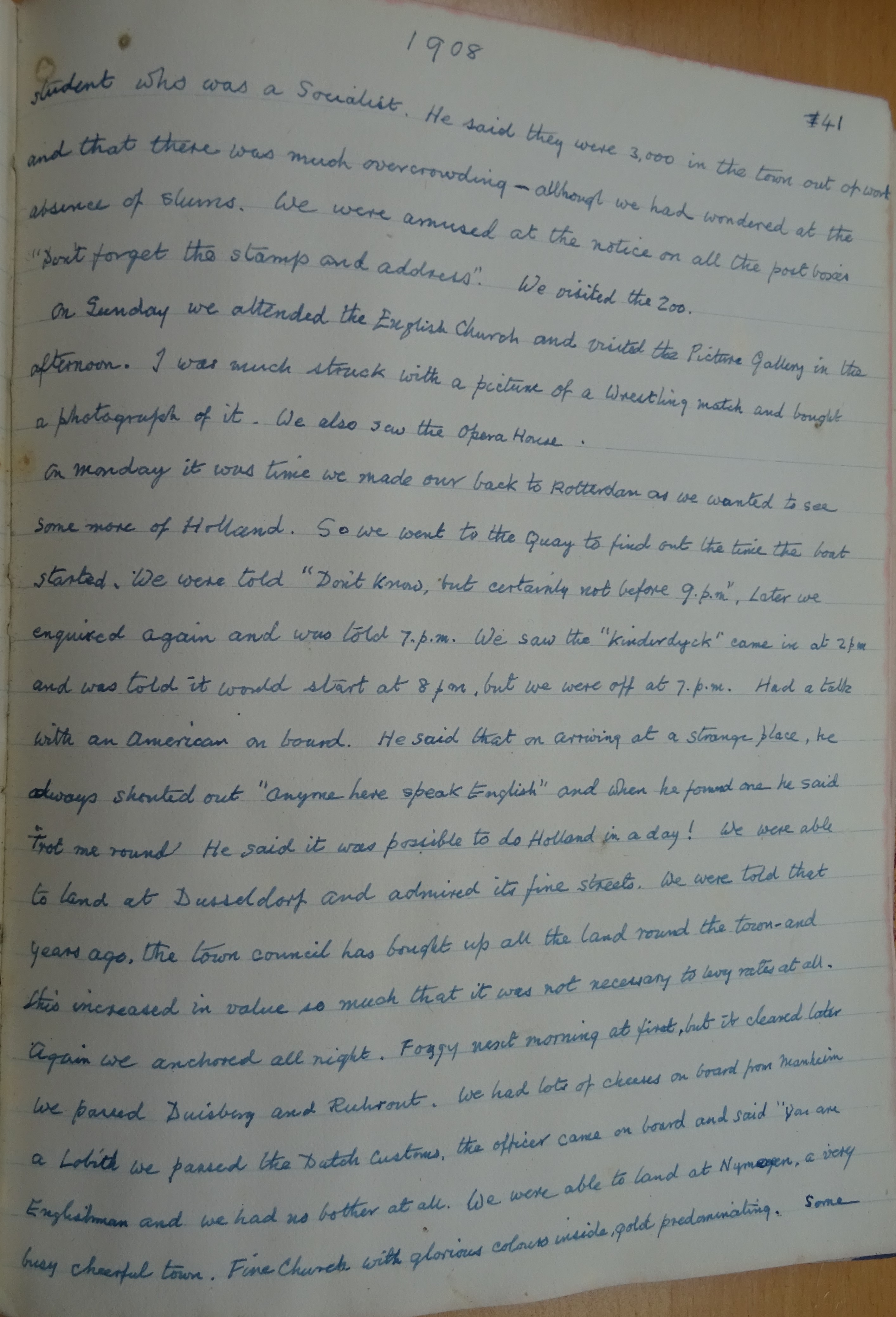
I met Gilbert and we visited the zoo. Gilbert had met a German student who was a Socialist. He said they were 3,000 in the town out of work and that there was much overcrowding - although we had wondered at the absence of slums. We were amused at the notice on all the post boxes, “Don’t forget the stamp and address.” We visited the zoo.
On Sunday we attended the English church and visited the picture gallery in the afternoon. I was much struck with a picture of a wrestling match and bought a photograph of it. We also saw the Opera House.
On Monday it was time we made our way back to Rotterdam as we wanted to see some more of Holland. So we went to the Quay to find out the time the boat started. We were told, “Don’t know, but certainly not before 9 pm.” Later we enquired again and was told 7 pm. We saw the “Kinderdyck” come in at 2 pm and was told it would start at 8 pm, but we were off at 7 pm. Had a talk with an American on board. He said that on arriving at a strange place, he always shoulder “anyone here speak English” and when he found one he said, “Trot me round”. He said it was possible to do Holland in a day! We were able to land at Düsseldorf and admired its fine streets. We were told that years ago, the Town Council had bought up all the land round the town and this increased in value so much that it was not necessary to levy rates at all.
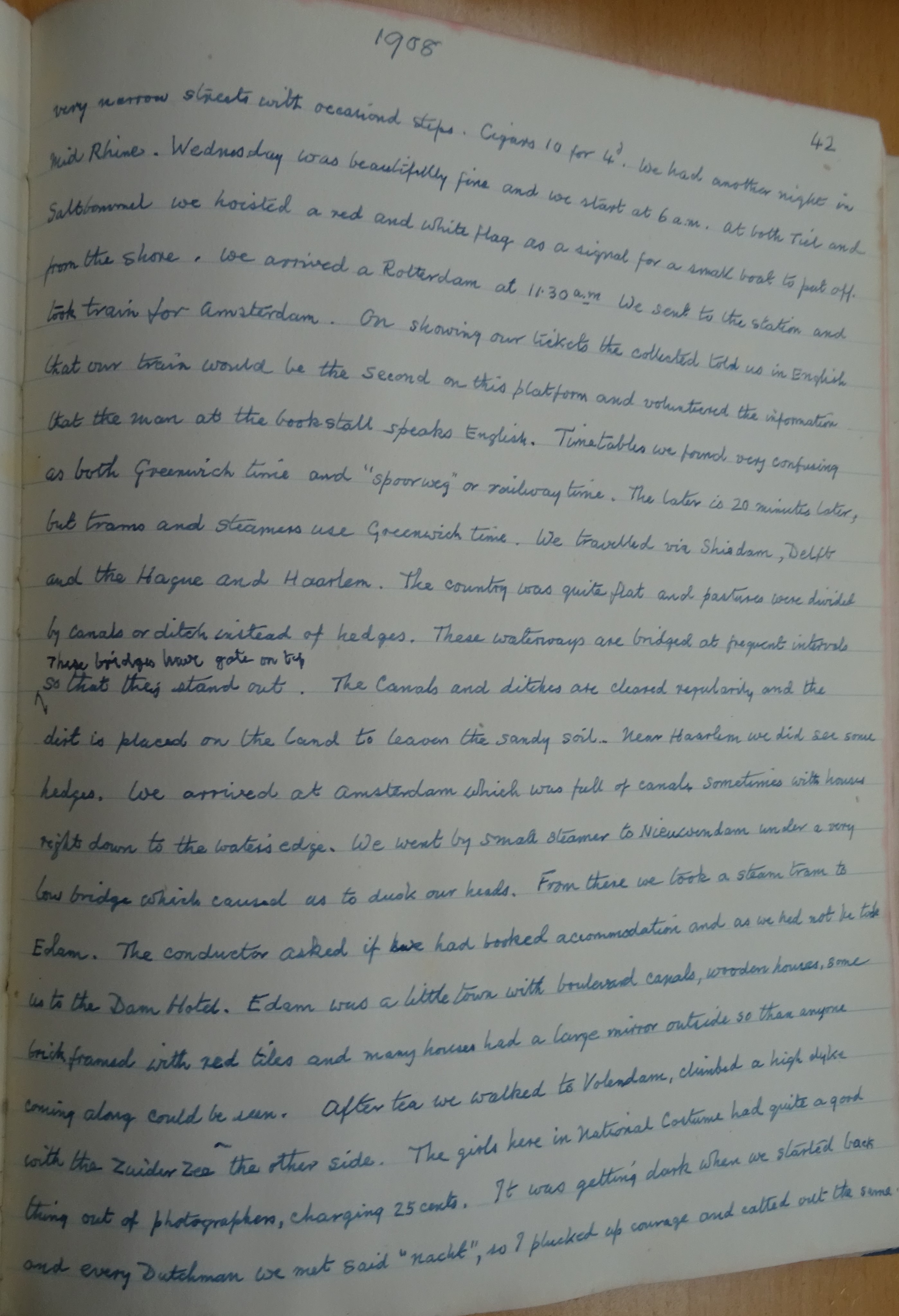
Again we anchored all night. Foggy next morning at first, but it cleared later. We passed Duisburg and Ruhrout. We had lots of cheeses on board from Manheim and Lobito we passed the Dutch customs, the officer came on board and said, “You are Englishman and we had no bother at all. We were able to land at Nymegen, a very busy cheerful town. Fine church with glorious colours inside, gold predominating. Some very narrow streets with occasional steps. Cigars 10 for 4d. We had another night in Mid Rhine. Wednesday was beautifully fine and we start at 6 am. At both Tiel and Saltbommel we hoisted a red and white flag as a signal for a small boat to put off from the shore. We arrived at Rotterdam at 11.30 am. We went to the station and took train for Amsterdam. On showing our tickets the collector told us in English that our train would be the second on this platform and volunteered the information that the man at the bookstall speaks English. Timetables we found very confusing as both Greenwich time and “spoorweg” or railway time. The latter is 20 minutes later, but trams and steamers use Greenwich time. We travelled via Shiedam, Delft and The Hague and Harlem. The country was quite flat and pastures were divided by canals or ditch instead of hedges. These waterways are bridged at frequent intervals so that they stand out. These bridges have gate on top. The canals and ditches are cleared regularly and the dirt is placed on the land to leaven the sandy soil. Near Haarlem we did see some hedges. We arrived at Amsterdam which was full of canals, sometimes with houses right down to the water’s edge. We went by small steamer to Nieuwendam under a very low bridge which caused us to duck our heads. From there we took a steam tram to Edam. The conductor asked if we had booked accommodation and as we had not he took us to the Dam Hotel. Edam was a little town with boulevard canals, wooden houses, some brick framed with red tiles and many houses had a large mirror outside so there anyone coming along could be seen. After tea we walked to Volendam, climbed a high dyke with the Zuider Zee the other side. The girls here in national costume ha quite a good thing out of photographers, charging 25 cents. It was getting dark when we started back and every Dutchman we met said “nacho”, so I plucked up courage and called out the same.
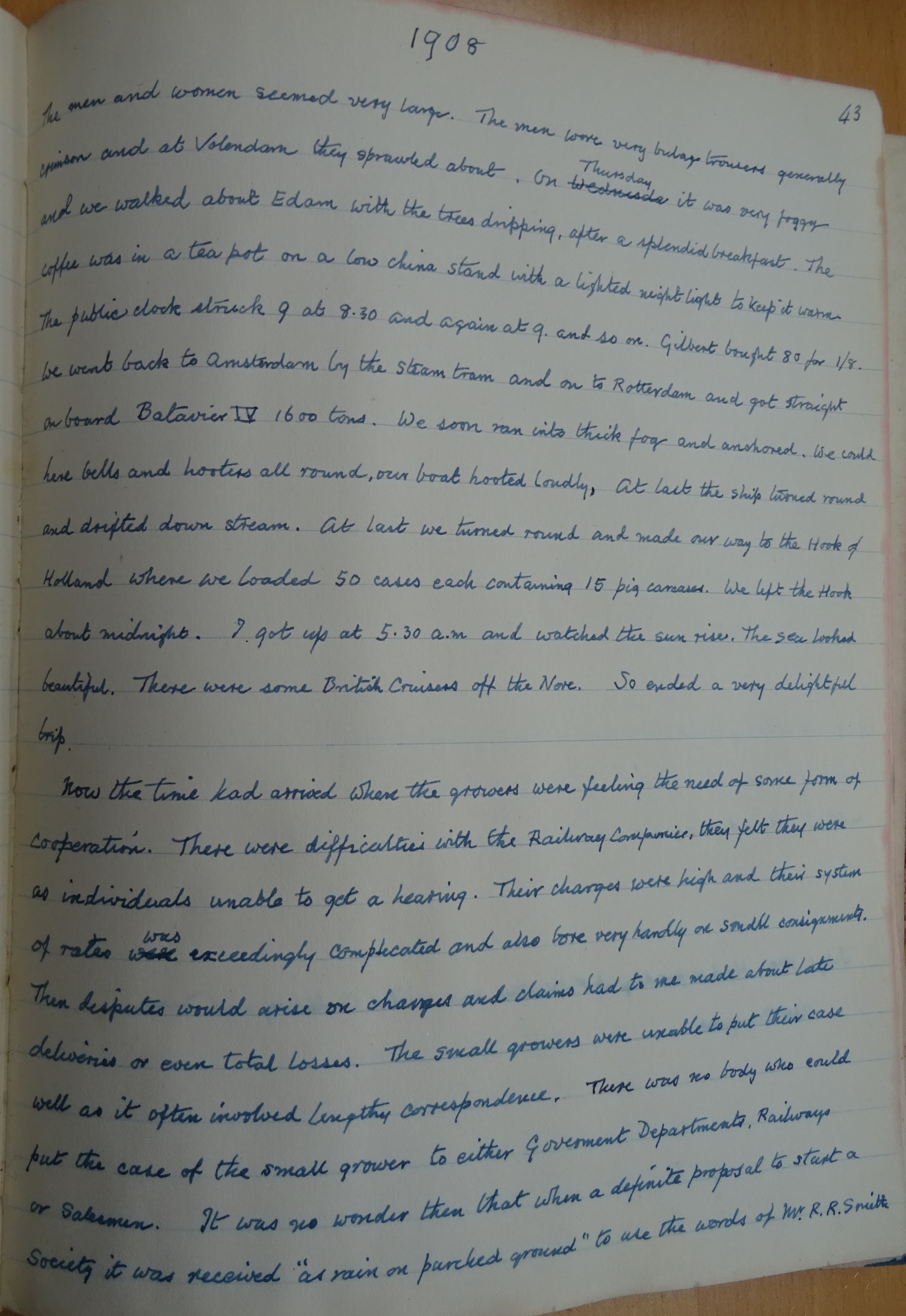
The men and women seemed very large. The men wore very bulgy trousers generally crimson and at Volendam they sprawled about. On Thursday it was very foggy and we walked about Edam with the trees dripping, after a splendid breakfast. The coffee was in a tea pot on a low china stand with a lighted gift light to keep it warm. The public clock struck 9 at 8.30 and again at 9 and so on. Gilbert bought 80 for 1/8. We went back to Amsterdam by the steam tram and on to Rotterdam and got straight on board Batavier IV 1600 tons. We soon ran into thick fog and anchored. We could hear bells and hooters all round, our boat hooted loudly. At last the ship turned round and drifted downstream. At last we turned round and made our way to the Hook of Holland where we loaded 50 cases each containing15 pig carcasses. We left the Hook about midnight. I got up at 5.30 am and watched the sun rise. The sea looked beautiful. There were some British cruisers off the Nove. So ended a very delightful trip.
Now the time had arrived where the growers were feeling the need of some form of co-operation. There were difficulties with the Railway Companies, they felt they were as individuals unable to get a hearing. Their charges were high and their system of rates was exceedingly complicated and also bore very hardly on small consignments. Then disputes would arise on charges and claims had to be made about late deliveries or even total losses. The small growers were unable to put their case well as it often involved lengthy correspondence. There was a no body who could put the case of the small grower to either Government Departments, Railways or Salesmen. It was no wonder then that when a definite proposal to start a Society it was received “as rain on parched ground” to use the words of Mr R R Smith of South Littleton, a neighbouring village.
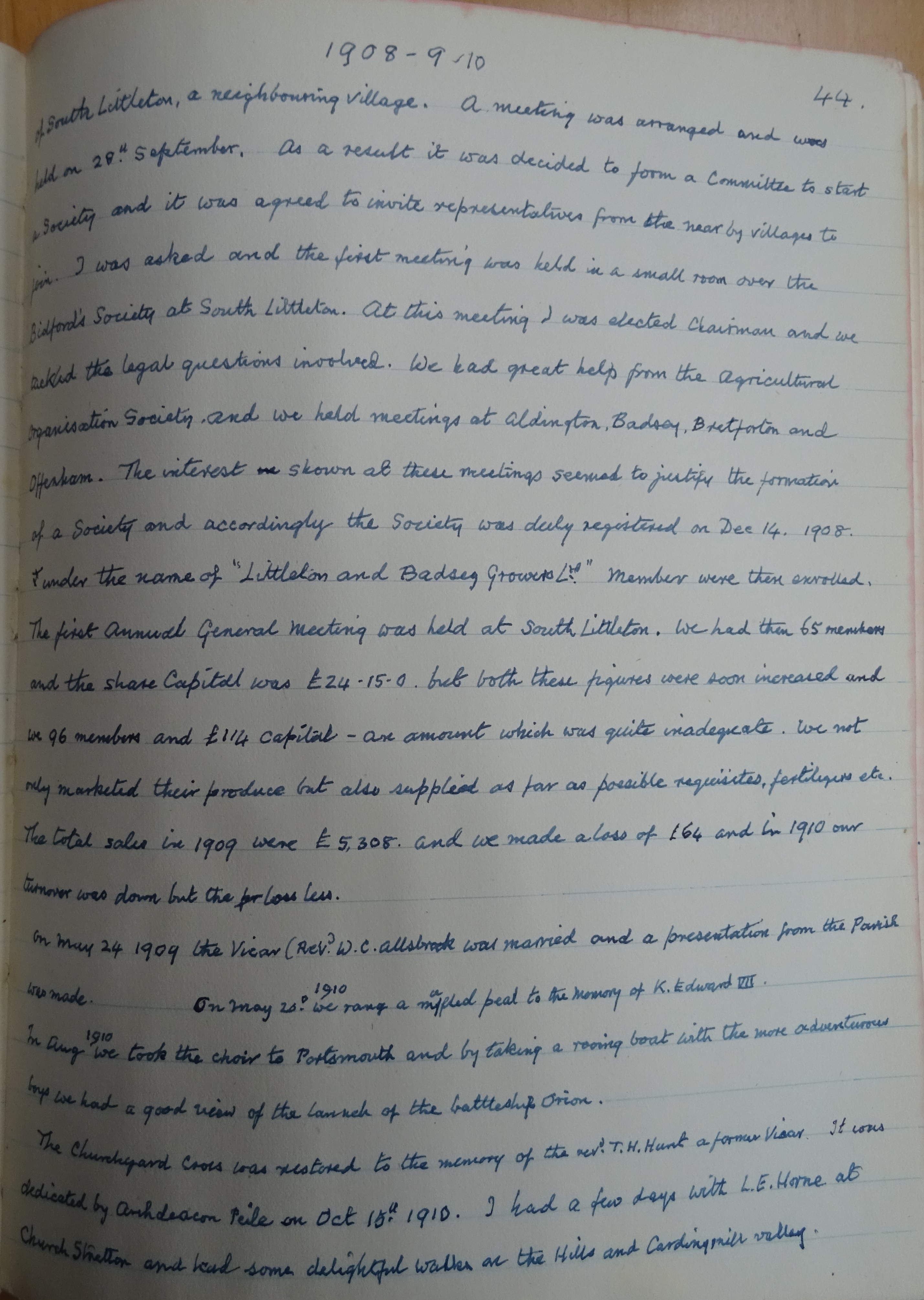
A meeting was arranged and was held on 28th September. As a result it was decided to form a Committee to start a Society and it was agreed to invite representatives from the nearby villages to join. I was asked and the first meeting was held in a small room over the Bidford’s Society at South Littleton. At this meeting I was elected Chairman and we tackled the legal questions involved. We had great help from the Agricultural Organisation Society and we held meetings at Aldington, Badsey, Bretforton and Offenham. The interest shown at these meetings seemed to justify the formation of a Society and accordingly the Society was duly registered on Dec 14 1908 under the name of “Littleton and Badsey Growers Ltd”. Members were then enrolled.
1909
The first Annual General Meeting was held at South Littleton. We had then 65 members and the share capital was £24.15.0 but both these figures were soon increased and soon we had 96 members and £114 capital - an amount which was quite inadequate. We not only marketed their produce but also supplied as far as possible requisites, fertilisers etc. The total sales in 1909 were £5,308 and we made a loss of £64 and in 1910 our turnover was down but the loss less.
On May 24 1909 the Vicar, Reverend W C Allsebrook, was married and a presentation from the Parish was made.
A little boy, Ernest Evans, died on Aug 29. I often visited him and he was often given money by visitors. When he had sufficient he ordered a load of coal to be delivered for his mother! He had a long and painful illness caused by an accident.
1910
On May 26th 1910 we rang a muffled peal to the memory of King Edward VII.
July 1 1910 had a few days at Folkestone and visited Canterbury and Dover, also Dungeness.
In Aug 1910 we took the choir to Portsmouth and by taking a rowing boat with the more adventurous boys we had a good view of the launch of the battleship Orion.
The churchyard cross was restored to the memory of the Reverend T H Hunt, a former Vicar. It was dedicated by Archdeacon Peile on Oct 18th 1910.
I had a few days with L E Horne at Church Stretton and had some delightful walks on the hills and Cardingmill Valley.
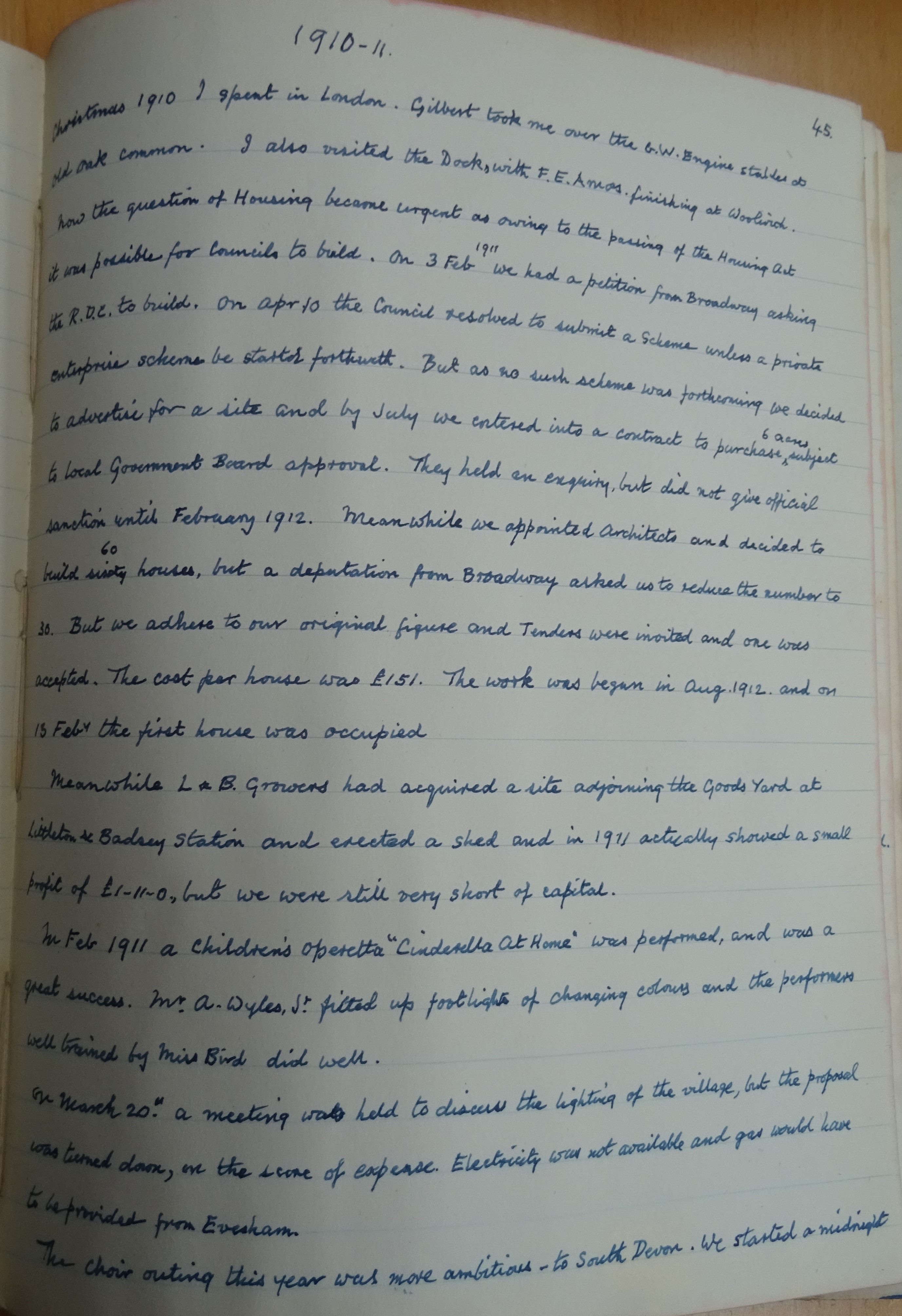
Christmas 1910 I spent in London. Gilbert took me over the GW Engine stables at Old Dock Common. I also visited the Docks with F E Amos finishing at Woolwich.
1911
Now the question of Housing became urgent as owing to the passing of the Housing Act it was possible for Councils to build. On 3 Feb 1911 we had a petition from Broadway asking the RDC to build. On Apr 10 the Council resolved to submit a scheme unless a private enterprise scheme be started forthwith. But as no such scheme was forthcoming we decided to advertise for a site and by July we entered into a contract to purchase 6 acres subject to Local Government Board approval. They held an enquiry, but did not give official sanction until February 1912. Meanwhile we appointed architects and decided to build 60 houses, but a deputation from Broadway asked us to reduce the number to 30. But we adhered to our original figure and tenders were invited and one was accepted. The cost per house was £151. The work was begun in Aug 1912 and on 13 February the first house was occupied.
Meanwhile L&B Growers had acquired a site adjoining the Goods Yard at Littleton & Badsey Station and erected a shed and in 1911 actually showed a small profit of £1.11.0, but we were still very short of capital.
In Feb 1911 a children’s operetta “Cinderella at Home” was performed, and was a great success. Mr A Wyles Senior fitted up footlights of changing colours and the performers well trained by Miss Bird did well.
On March 20th a meeting was held to discuss the lighting of the village, but the proposal was turned down, on the score of expense. Electricity was not available and gas would have to be provided from Evesham.
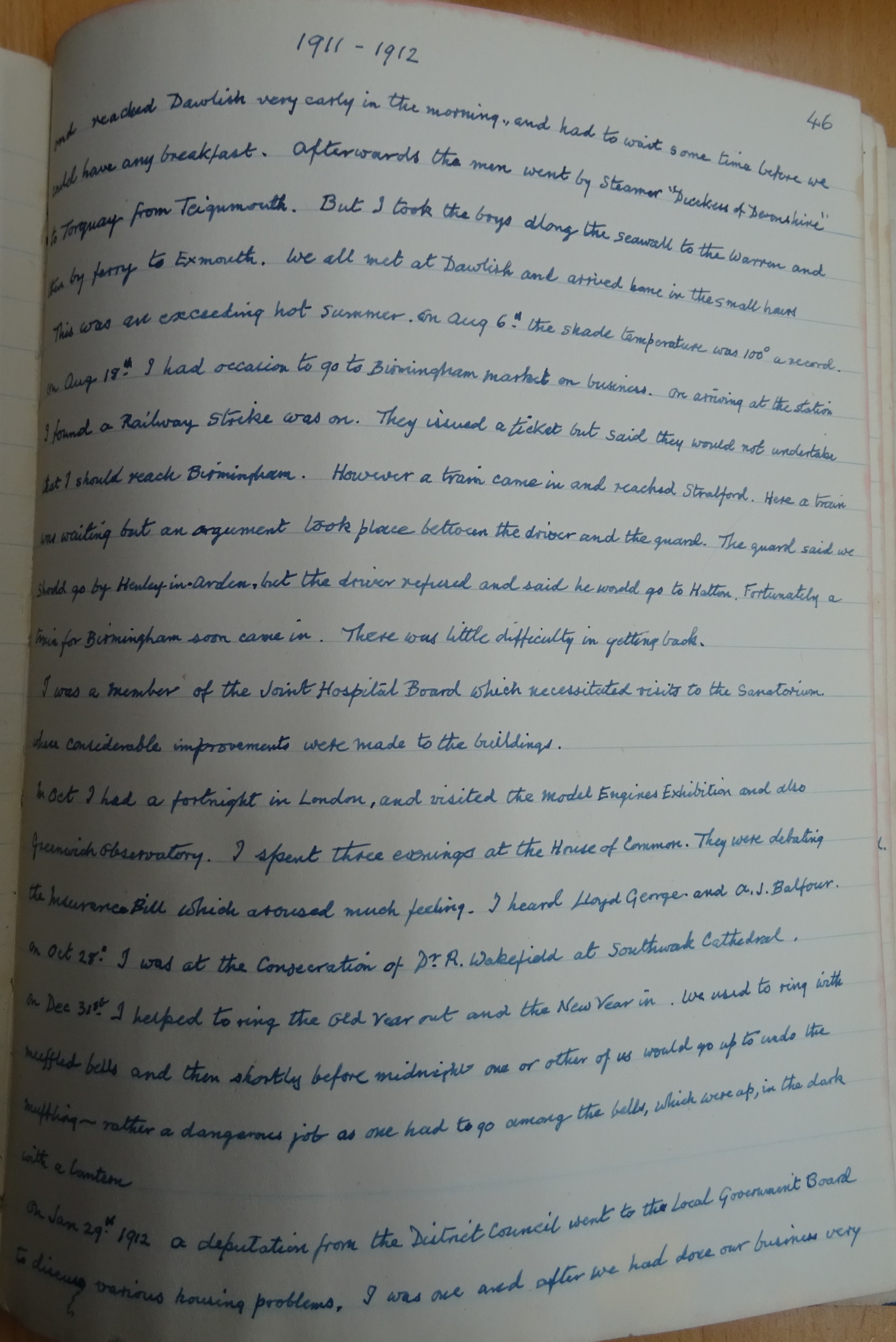
The choir outing this year was more ambitious – to South Devon. We started at midnight and reached Dawlish very early in the morning, and had to wait some time before we could have any breakfast. Afterwards the men went by steamer “Duchess of Devonshire” to Torquay from Teignmouth. But I took the boys along the sea wall to the Warren and then by ferry to Exmouth. We all met at Dawlish and arrived home in the small hours.
June 22 1911, coronation of King George V. There was an excellent display by the school girls of dancing round the maypole. Usual tea and presentation of cups. I went up Broadway Hill to see the fireworks.
This was an exceedingly hot summer. On Aug 6th the shade temperature was 100o a record.
On Aug 18th I had occasion to go to Birmingham market on business. On arriving at the station I found a railway strike was on. They issued a ticket but said they would not undertake that I should reach Birmingham. However a train came in and reached Stratford. Here a train was waiting but an argument took place between the driver and the guard. The guard said we should go by Henley-in-Arden, but the driver refused and said he would go to Hatton. Fortunately a train for Birmingham soon came in. There was little difficulty in getting back.
I was a member of the Joint Hospital Board which necessitated visits to the Sanatorium where considerable improvements were made to the buildings.
In Oct I had a fortnight in London, and visited the Model Engines Exhibition and also Greenwich Observatory. I spent three evenings at the House of Commons. They were debating the Insurance Bill which aroused much feeling. I heard Lloyd George and A J Balfour. On Oct 28th I was at the consecration of Dr R Wakefield at Southwark Cathedral.
On Dec 31st I helped to ring the Old Year out and the New Year in. We used to ring with muffled bells and then shortly before midnight one or other of us would go up to undo the muffling – rather a dangerous job as one had to go among the bells, which were up, in the dark with a lantern.
1912
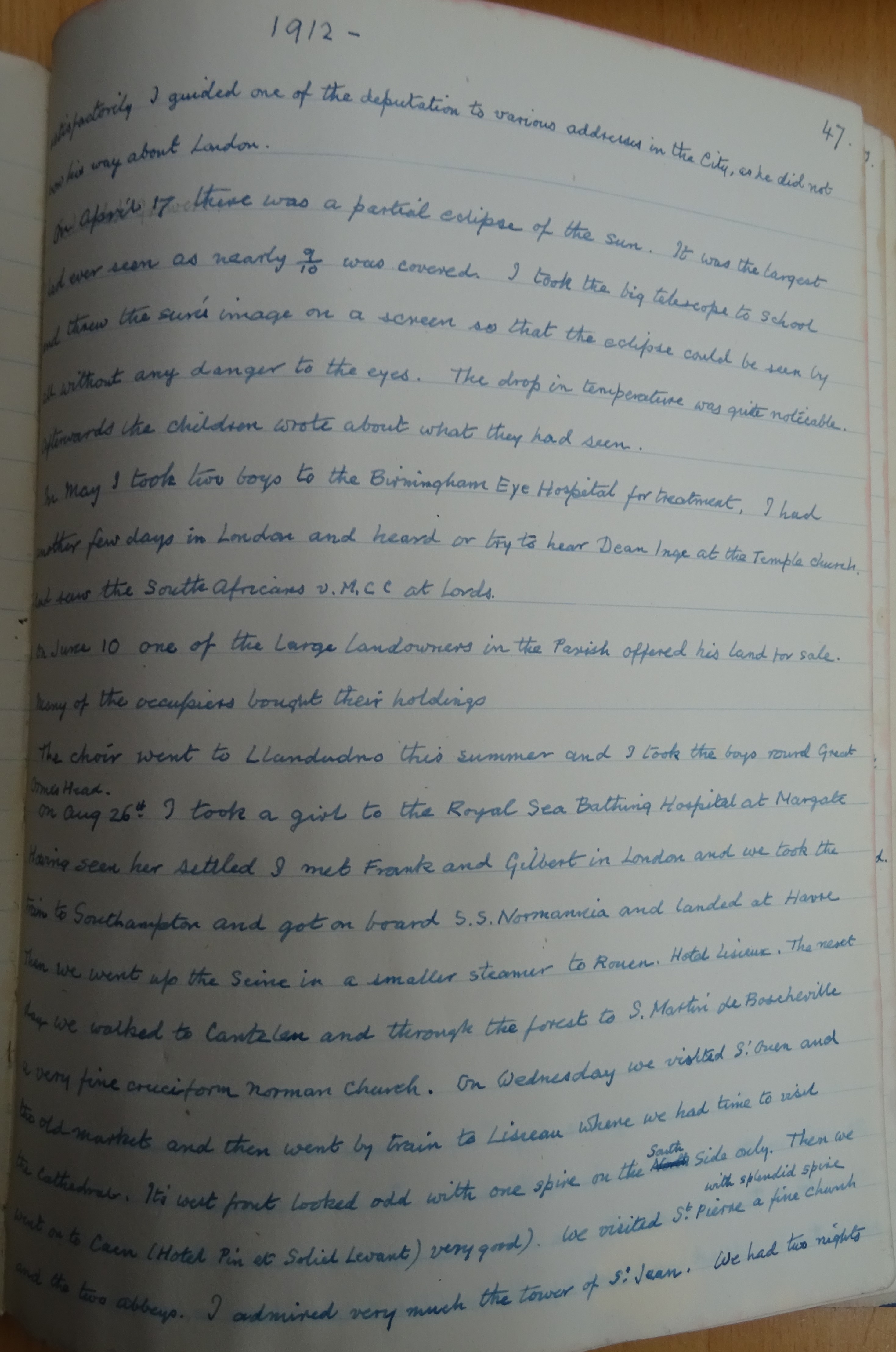
On Jan 29th 1912 a deputation from the District Council went to the Local Government Board to discuss various housing problems. I was one and after we had done our business very satisfactorily I guided one of the deputation to various addresses in the City, as he did not know his way about London.
On April 17 there was a partial eclipse of the sun. It was the largest I’d ever seen as nearly 9/10 was covered. I took the big telescope to school and threw the surci image on a screen so that the eclipse could be seen by all without any damage to the eyes. The drop in temperature was quite noticeable. Afterwards the children wrote about what they had seen.
In May I took two boys to the Birmingham Eye Hospital for treatment. I had another few days in London and heard or tried to hear Dean Inge at the Temple Church. And saw the South Africans v MCC at Lords.
On June 10 one of the large landowners in the parish offered his land for sale. Many of the occupiers bought their holdings.
The choir went to Llandudno this summer and I took the boys round Great Orme Head.
On Aug 26th I took a girl to the Royal Sea Bathing Hospital at Margate. Having seen her settled I met Frank and Gilbert in London and we took the train to Southampton and got on board SS Normancia and landed at Havre, then we went up the Seine in a smaller steamer to Rouen, Hotel Lisieux. The next day we walked to Canteleu and through the forest to S Martin de Boucheville, a very fine cruciform Norman church. On Wednesday we visited St Ouen and the old market and then went by train to Lisieau where we had time to visit the cathedral. Its west front looked odd with one spire on the south side only. Then we went on to Caen (Hotel Pin et Soleil Levant - very good). We visited St Pierre with splendid spire, a fine church, and the two abbeys. I admired very much the tower of St Jean. We had two nights …..
[Page 48 missing]
1913
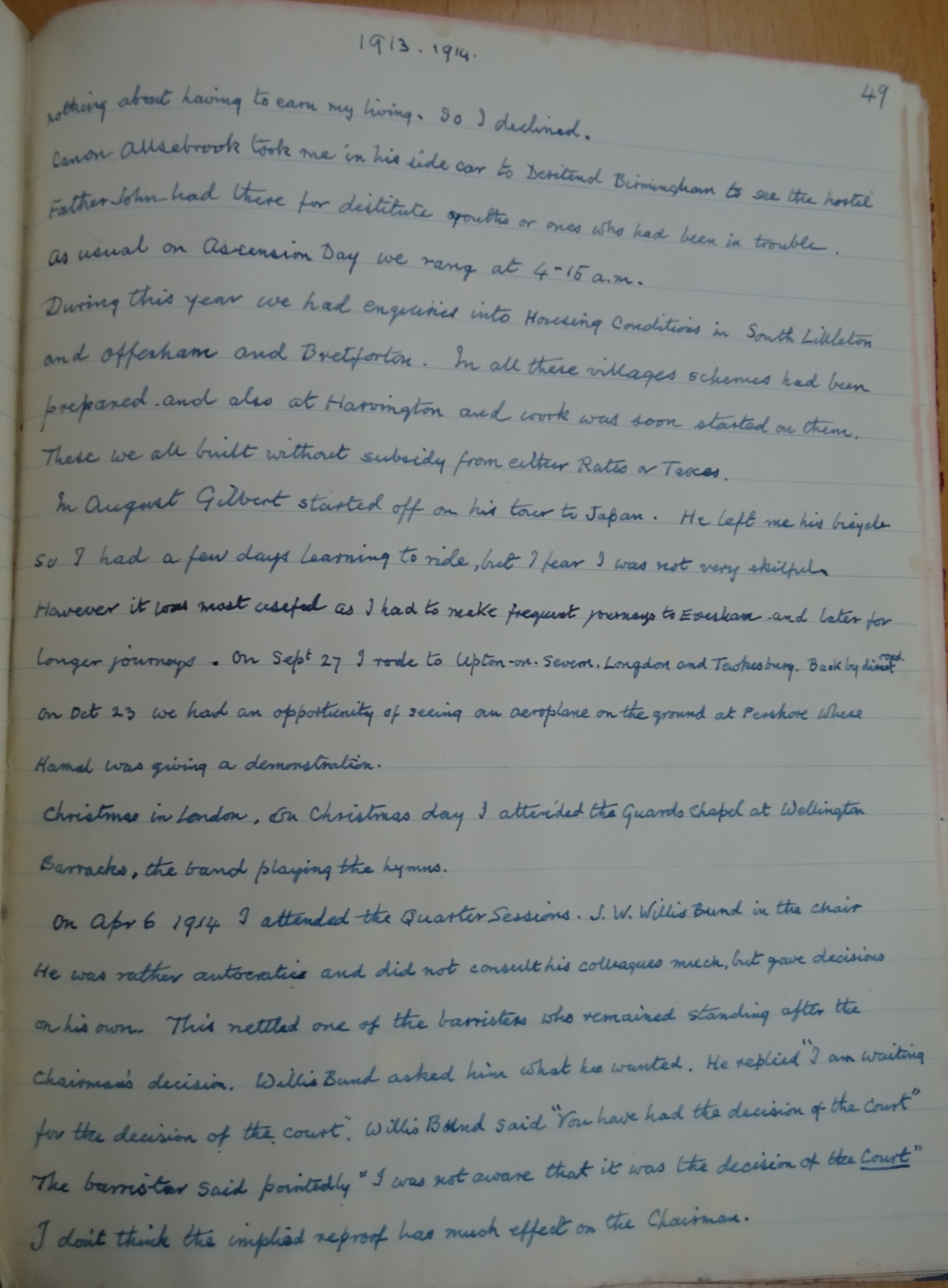
….. nothing about having to earn my living. So I declined.
Canon Allsebrook took me in his side car to Deritend, Birmingham, to see the hostel Father John had there for destitute youths or ones who had been in trouble.
As usual on Ascension Day we rang at 4.15 am.
During this year we had enquiries into Housing conditions in South Littleton and Offenham and Bretforton. In all these villages schemes had been prepared, and also at Harrington and work was soon started on them. These we all built without subsidy from either rates or taxes.
In August Gilbert started off on his tour to Japan. He left me his bicycle so I had a few days learning to ride, but I fear I was not very skilful. However it was most useful as I had to make frequent journeys to Evesham and later for longer journeys. On Sept 27 I rode to Upton-on-Severn, London and Tewkesbury, back by direct road.
On Oct 23 we had an opportunity of seeing an aeroplane on the ground at Pershore where Hamal was giving a demonstration.
Christmas Day in London. On Christmas Day I visited the Guards’ Chapel at Wellington Barracks, the band playing the hymns.
1914
On Apr 6 1914 I attended the Quarter Sessions. J W Willis Bund in the chair. He was rather autocratic and did not consult his colleagues much, but gave decisions on his own. This nettled one of the barristers who remained standing after the Chairman’s decision. Willis Bund asked him what he wanted. He replied, “I am waiting for the decision of the court.” Willis Bund said, “You have had the decision of the court.” The barrister said pointedly, “I was not aware that it was the decision of the court.” I don’t think the implied reproof had much effect on the Chairman.
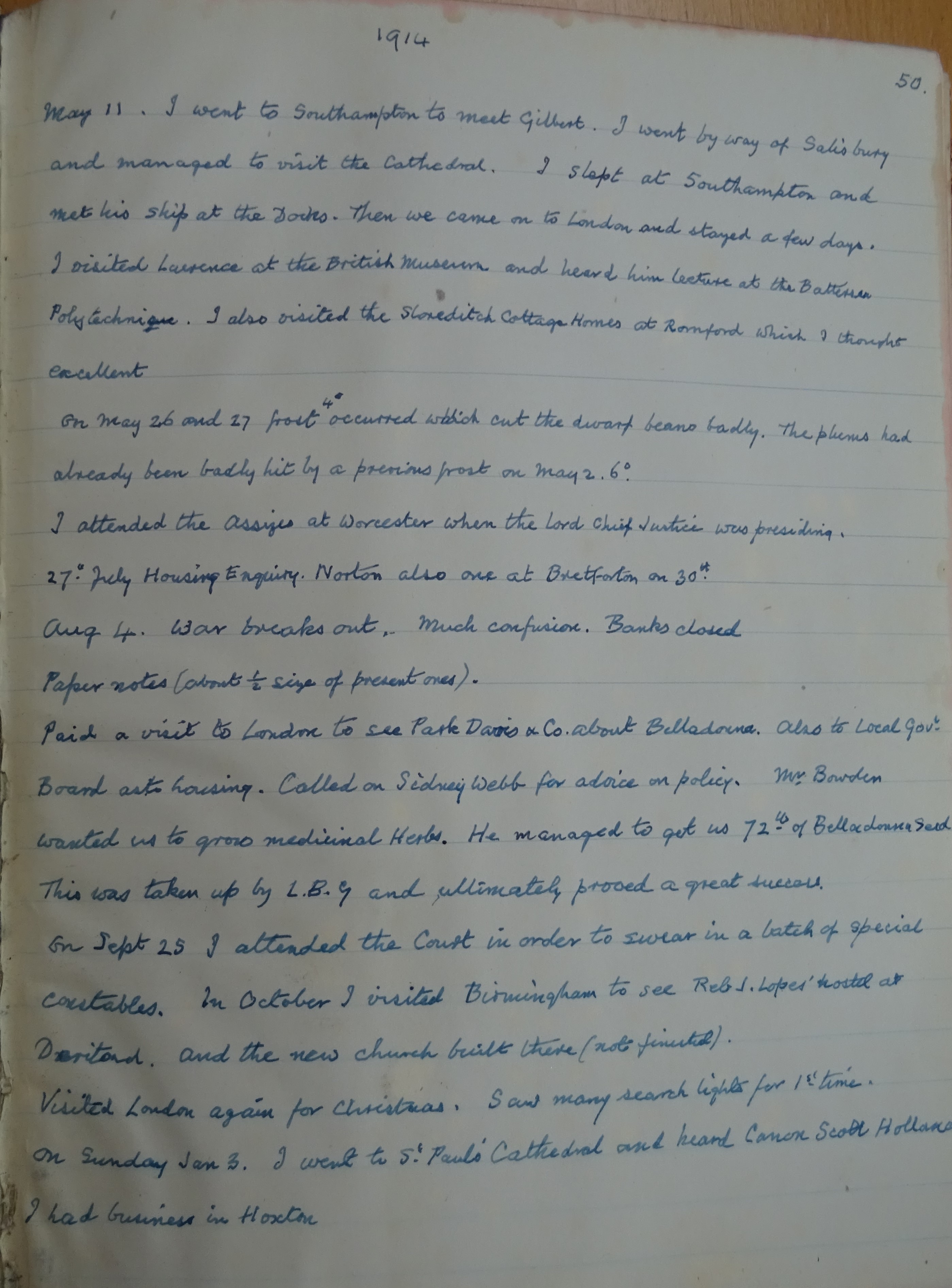
May 11. I went to Southampton to meet Gilbert. I went by way of Salisbury and managed to visit the Cathedral. I slept at Southampton and met his ship at the Docks. Then we came on to London and stayed a few days. I visited Laurence at the British Museum and heard him lecture at the Battersea Polytechnic. I also visited the Shoreditch Cottage Homes at Romford which I thought excellent.
On May 26 and 27 frost 4o occurred which cut the dwarf beans badly. The plums had already been badly hit by a previous frost on May 2, 6o.
I attended the Assizes at Worcester when the Lord Chief Justice was presiding.
27th July Housing Enquiry. Norton also one at Bretforton on 30th.
Aug 4. War breaks out. Much confusion. Banks closed. Paper notes (about half size of present ones).
Paid a visit to London to see Park Davis & Co about Belladonna. Also to Local Government Board as to housing. Called on Sidney Webb for advice on policy. Mr Bowden wanted us to grow medicinal herbs. He managed to get us 72 lb of Belladonna seed. This was taken up by LBG and ultimately proved a great success.
On Sept 25 I attended the Court in order to swear in a batch of Special Constables. In October I visited Birmingham to see Reverend J Lopes’ hostel at Deritend and the new church built there (not finished).
Visited London again for Christmas. Saw many search lights for first time. On Sunday Jan 3 I went to St Paul’s Cathedral and heard Canon Scott Holland. I had business in Horton.
* * * * *
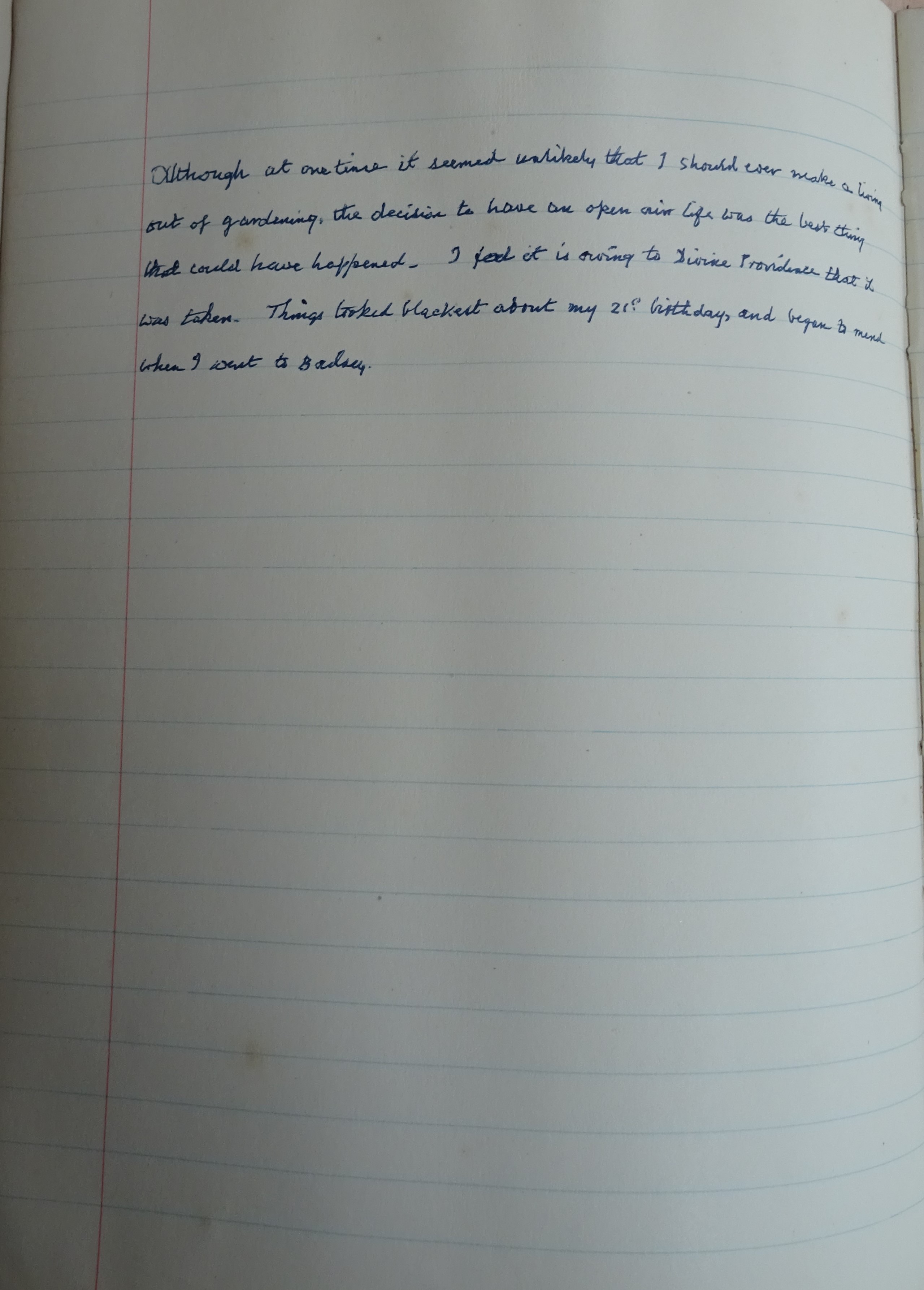
Although at one time it seemed unlikely that I should ever make a living out of gardening, the decision to have an open air life was the best thing that could have happened. I feel it is owing to Divine Providence that it was taken. Things looked blackest about my 21st birthday and began to mend when I went to Badsey.