
In 1836, the Tithe Commutation Act was introduced to bring an end to the system of tithes in England, where tenants had to pay the landowner with one tenth of the produce on their land. As part of this procedure, in each village, a tithe map was produced, together with a list of landowners, tenants, acreage, names of the parcel of lands and the tithes paid. These amounts were paid at this time, rather than produce. In 1842, a tithe map and list were produced for Wickhamford, which showed that nearly all of the acreage was owned by Lord Sandys of Ombersley. The only exceptions were 9 acres owned by Anna Savage, a third of an acre by William Fisher and a little over half an acre by Sir Thomas Phillipps. There were also, at that time two areas owned by the Church, for the use of the vicar, called Badsey Glebes.
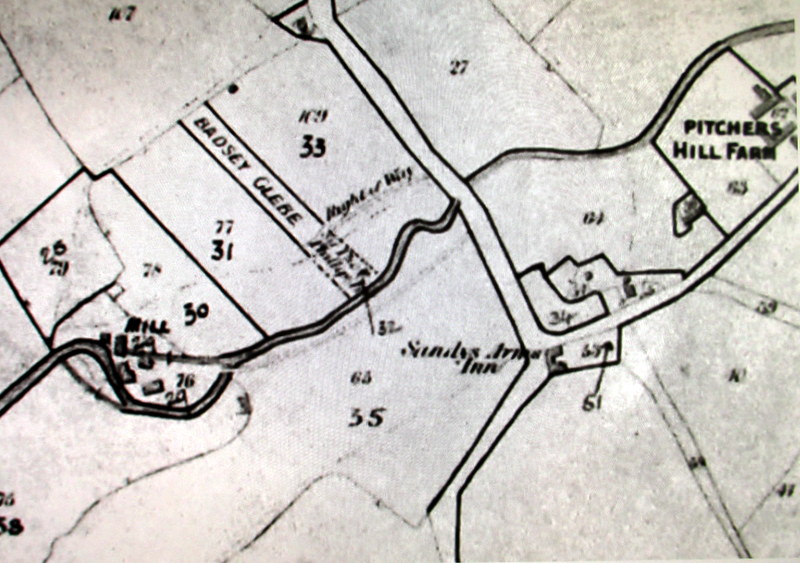
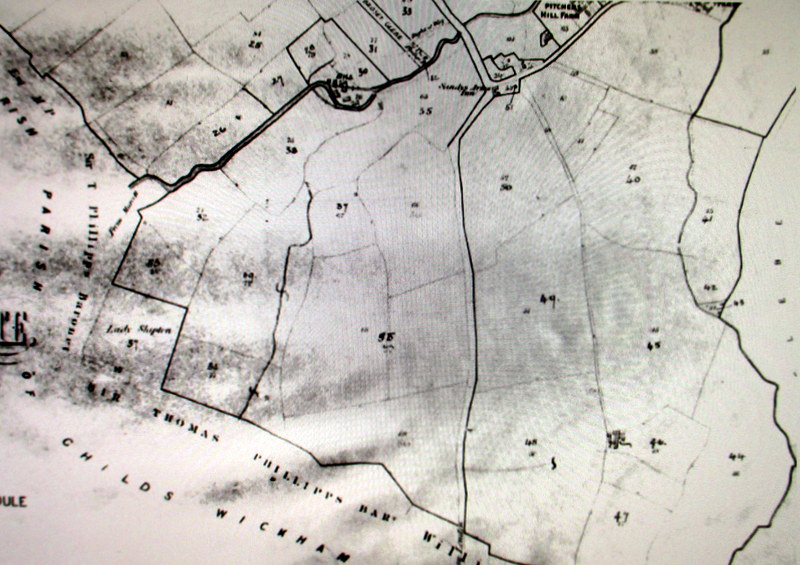
The land owned by Sir Thomas Phillipps was situated between Wickhamford Mill and the turnpike road through the parish, from Evesham to Broadway. In area, it was recorded as 0 acres, 2 roods and 31 perches and his tenant was John Gibbs, of Field Farm, who was paying nothing for the tithe. The plot was alongside Badsey Brook and extended southwestwards and beyond it was one of the Badsey Glebes. The map showed the location of his plot, marked as number 32 and called ‘Old Orchard’, and it had a Right of Way at the end of the land, with access to the turnpike road. His name was added on a later map from 1869, which was based on the 1842 map, and this is shown below.
Today, the main road is straighter, bypassing the loop to the Sandys Arms, and the area of Sir Thomas’ land now meets the A44 where the brook passes under it in a tunnel. The land he owned, and the Badsey Glebe, are now part of a larger field which combines fields 31 and 33 on the map.
Sir Thomas Phillipps had inherited this plot from his father, also Thomas Phillipps, who had died in 1819. In his father’s Will, there was a long list of properties, including his ‘Manor of Childswickham’. The properties were left to trustees and Sir Thomas Phillipps was recorded as life tenant, taking only income from most of them. He was, however, permitted to sell some of the properties if the income was insufficient for him.
Sir Thomas Phillipps, the bibliophile
Thomas Phillipps was born in 1792, in Ashton-under-Lyne, Cheshire, the illegitimate son of a textile manufacturer, but he inherited a substantial estate. From an early age he collected books and he attended Rugby School and University College, Oxford. In 1820 he was elected a Fellow of the Royal Society. At the censuses of 1841, 1851 and 1861 he was living at Middle Hill, a large property near Broadway Tower, which he also owned. For the 1861 census, it was recorded that he was a Baronet (which had been awarded in 1821), a Deputy Lieutenant of Worcestershire and had an M.A degree from Oxford. His wife was Elizabeth and there were eight other residents in the property, including servants and permanent guests.
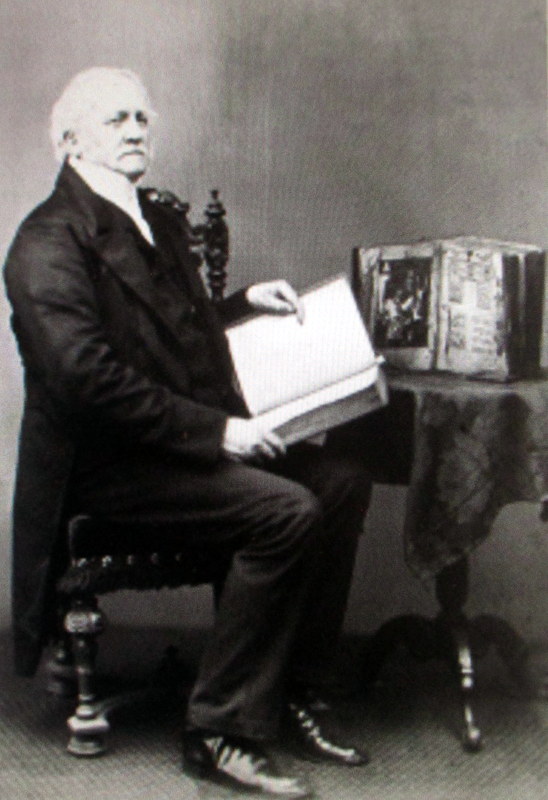
Sir Thomas Phillipps was known to visit bookshops and purchase the entire stock for his collection. Eventually, about sixteen of the twenty rooms at Middle Hill would be used to store his books. One visitor (Sir Frederic Madden, Keeper of Manuscripts at the British Museum) remarked that the house was dilapidated with heaps of book everywhere, the windows were never opened and the smell was almost unbearable. Sir Thomas later moved to Thirlestaine House in Cheltenham and over 100 wagon-loads of books and manuscripts were needed for the move.
He died in 1872 and was buried in a family vault in St Eadburgha’s Church, Broadway. In one obituary, he was referred to as Lord of the Manor of Childswickham. Despite his Will stipulating that the book collection should remain intact, in 1885 the Court of Chancery ruled that this was too restrictive and the books were sold over the next 120 years, with the last lots being sold by Christies in 2006!
Why did his father buy the Wickhamford land?
The land ownership mystery remains. It is unlikely that Thomas Phillipps Senior was planning to build a house on the Wickhamford land, as being close to Badsey Brook would have left it vulnerable to flooding. The tenant in 1842 was John Gibbs, who lived in a sizable house and rented many fields in the village. It is uncertain if Sir Thomas Phillipps continued to own the land up until his death in 1872, but he may have sold it previously.
An article on Wickhamford in the Birmingham Daily Gazette of 20th January 1868 stated that “Sir Thomas Phillipps is said to be lord of the manor, and Lord Sandys is a principal landowner; but there is no resident gentry.” Did Thomas Phillipps senior buy the Lord of the Manor title from Lord Sandys but had to purchase some land in the village as part of the procedure? If the report is correct, although the wording of ‘said to be’ is worrying, this might explain the ownership of the small bit of land. At the end of the land, away from Badsey Brook, a Right of Way existed that is today a Public Footpath. This goes from the main road past Wickhamford Mill and terminates at the Murcot Turn lane. On the other side of that road is the Parish of Childswickham where Sir Thomas Phillipps owned the land in 1869. The Right of Way would have given him unrestricted access to his small piece of land from his own holdings at one end, in Childswickham, and the turnpike road at the other end. This may have been significant in why Thomas Phillipps senior acquired that particular plot in Wickhamford, but we shall never know his thoughts and reasoning.
Tom Locke, March 2026
Acknowledgement
Thanks are due to David Ella for supplying details from the will of Thomas Phillipps Senior.